
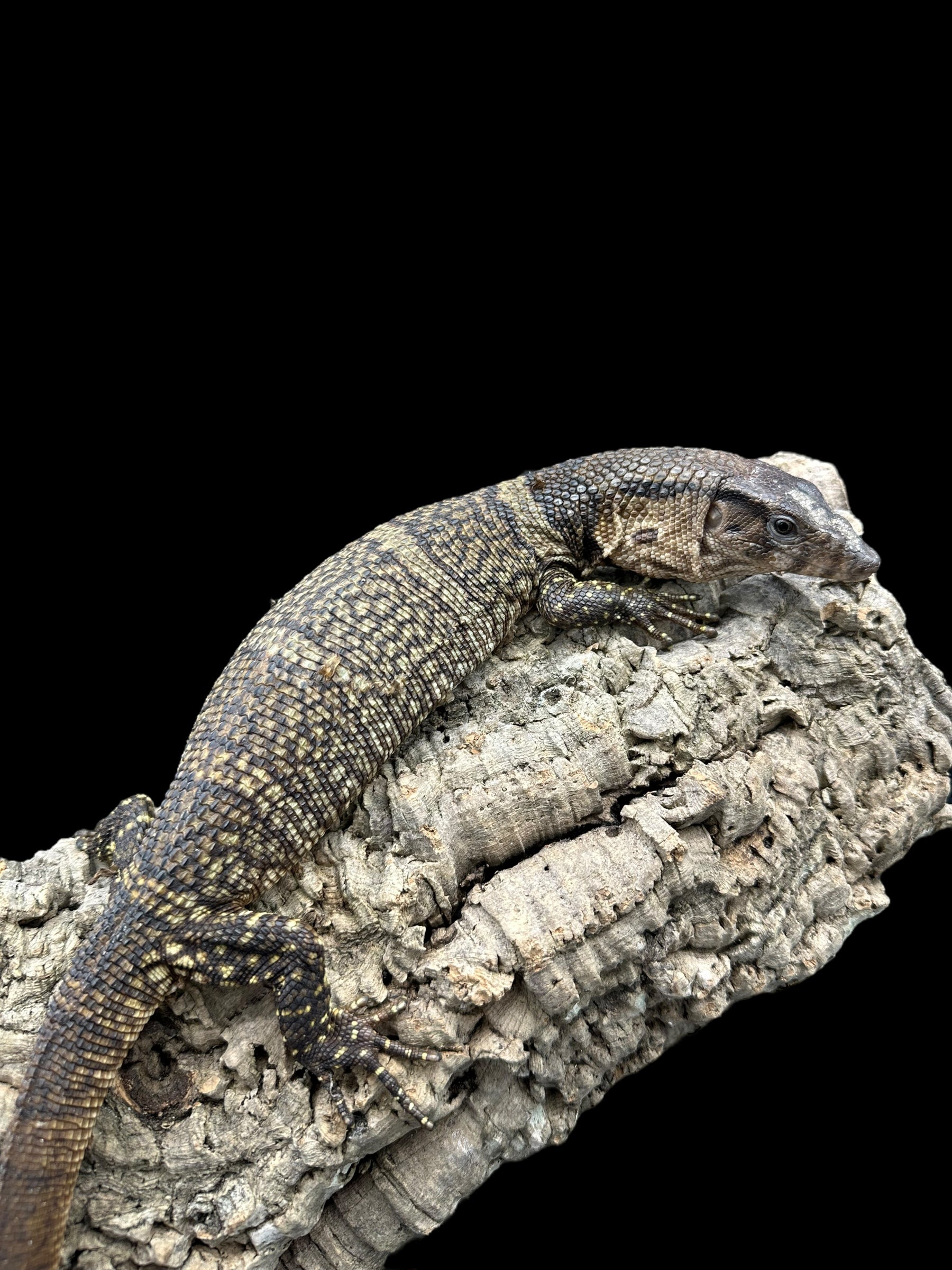
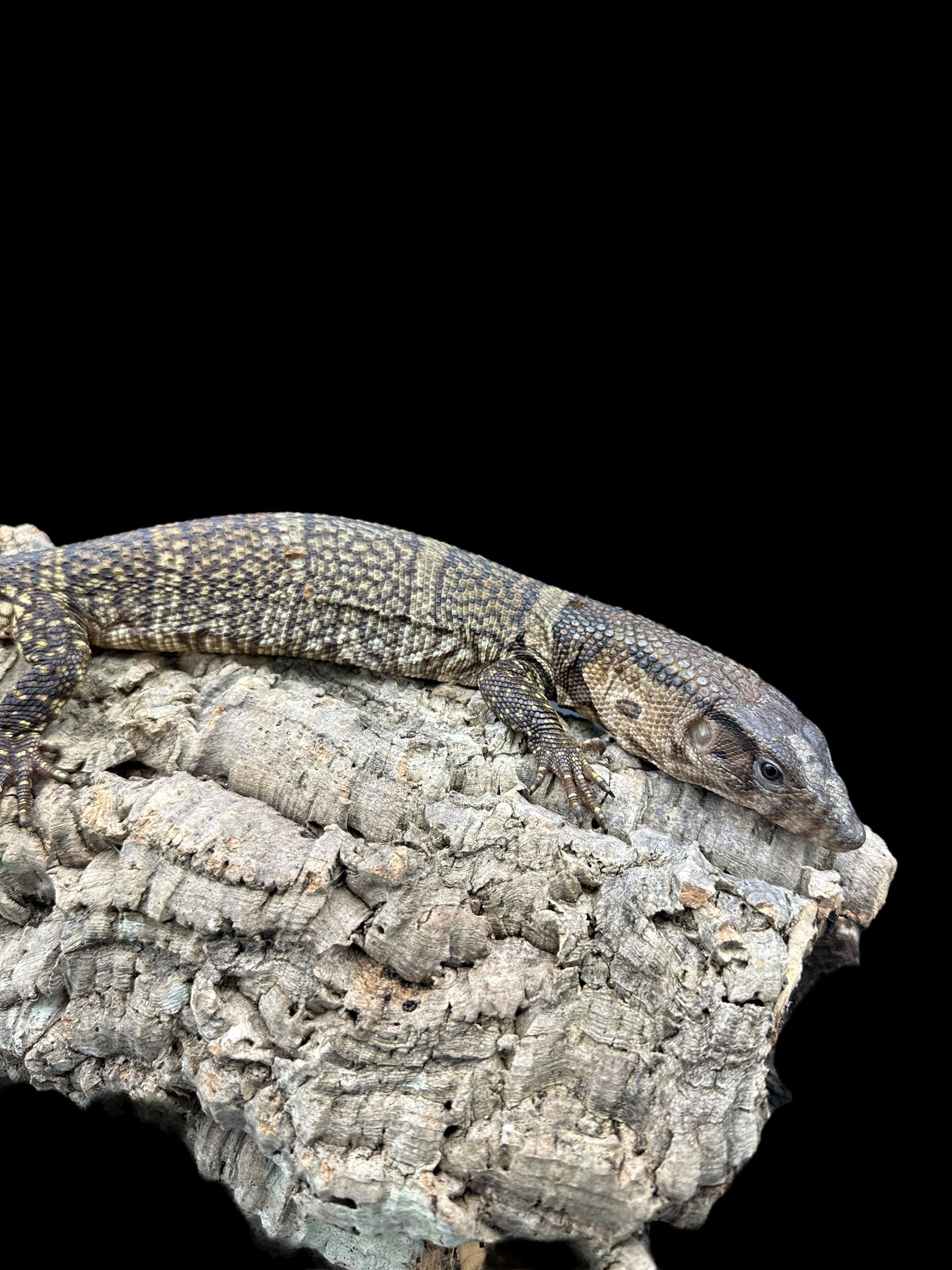
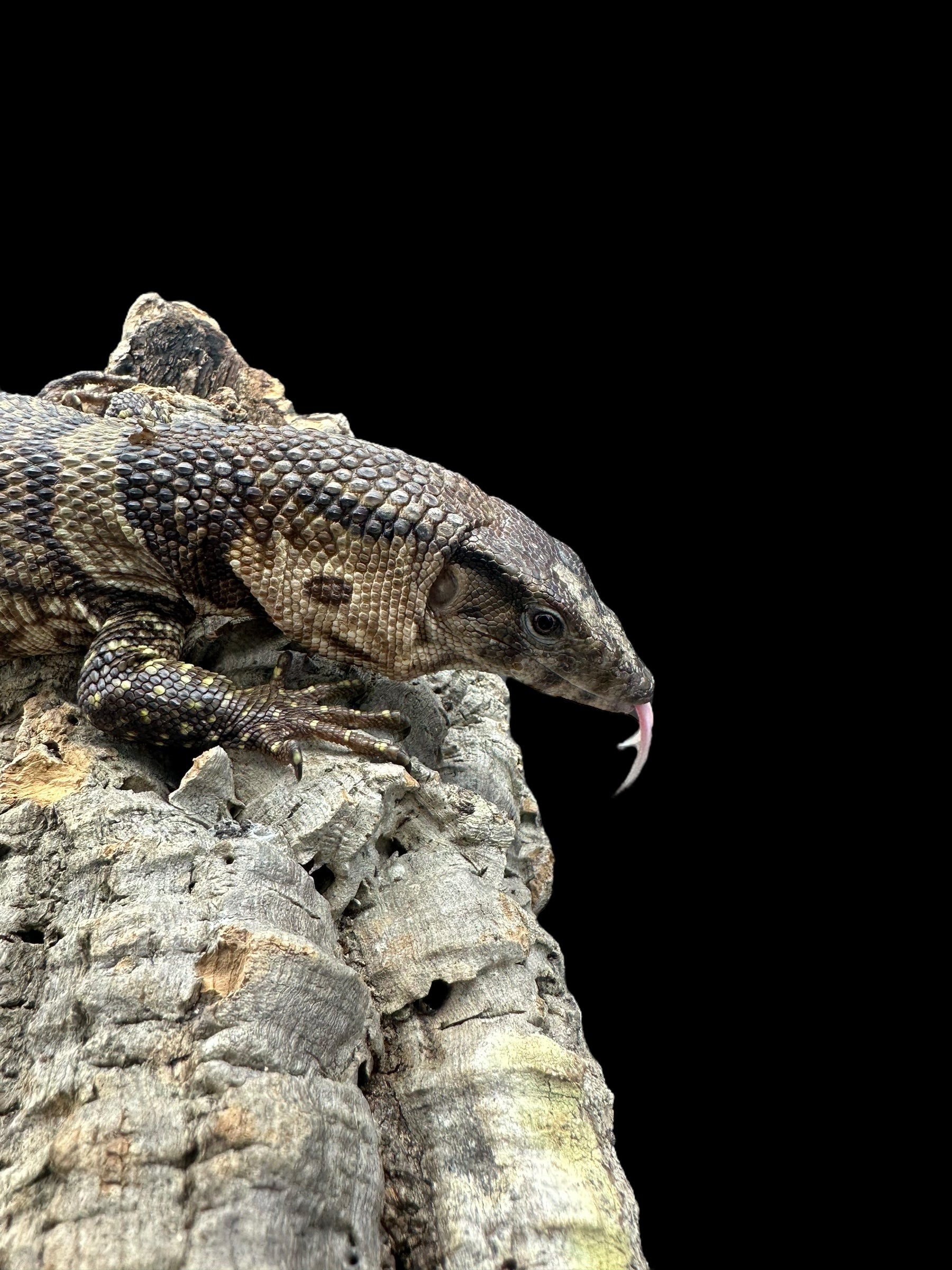
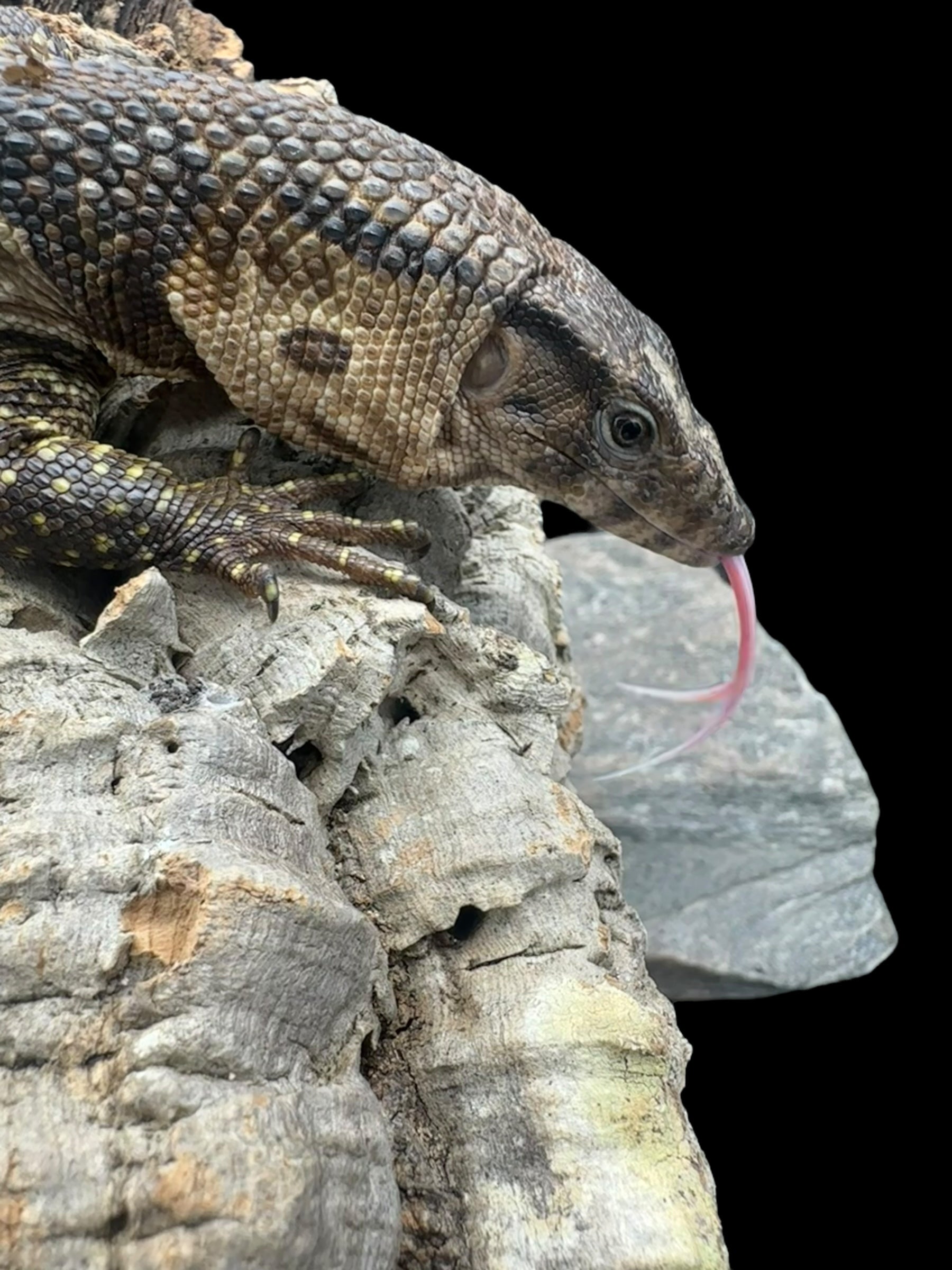


Photo Disclaimer
Description
Dumeril’s Monitor (Varanus dumerilii)
Scientific Name: Varanus dumerilii
Common Name: Dumeril’s Monitor, Brown Roughneck Monitor (not to be confused with V. rudicollis)
Species Overview
Size: Adults typically reach 3–4 feet (0.9–1.2 m) in total length, with some exceptional individuals approaching 4.5 feet (1.35 m). They are moderately heavy-bodied with muscular limbs and a long, powerful tail.
Appearance: Dumeril’s Monitors are striking, medium–large monitors with a dark brown or black base colour accented by cream, yellow, or tan ocelli and banding along the body and tail. Their heads are angular with pronounced ridges, and the neck region features slightly raised, coarse scales. The throat and underside are lighter, often with speckling. They have strong claws, a semi-prehensile tail, and expressive faces that give them a rugged, prehistoric appearance.
Distribution: Native to Southeast Asia, including southern Thailand, Peninsular Malaysia, Sumatra, Borneo, and nearby islands.
Habitat: This species inhabits swamp forests, mangroves, lowland rainforests, and riverine environments. They are semi-arboreal and semi-aquatic, frequently climbing trees and swimming through slow-moving water.
Behaviour: Dumeril’s Monitors are diurnal, intelligent, and active foragers. They are excellent climbers and strong swimmers. Their diet in the wild includes crustaceans, molluscs, insects, fish, amphibians, small mammals, and eggs. They may be defensive if threatened, using tail slaps, hissing, and strong bites as deterrents. With routine, many captive individuals become alert and tolerant of care, but they generally remain more cautious than some other monitor species.
Captive Care
Enclosure: Provide a spacious enclosure at least 8 feet × 4 feet × 4 feet (2.4 × 1.2 × 1.2 m) for an adult. Vertical climbing structures, large branches, cork rounds, and elevated platforms are important. Include a substantial water basin deep enough for full-body soaking and swimming. A soil–sand substrate mix (dry surface with retained moisture in deeper layers) supports burrowing.
Temperature and Humidity:
Basking area: 110–120°F (43–49°C)
Ambient temperature: 80–90°F (27–32°C)
Night temperatures: 75–80°F (24–27°C)
Humidity should be maintained between 60–80%, supported by the water feature, misting, and deep substrate.
Lighting: Provide strong full-spectrum lighting with high UVB (10–12%). Bright basking areas and shaded retreats should both be available. They benefit from intense lighting similar to that used for other large, active monitors.
Diet: Offer a varied carnivorous diet including crustaceans, fish, snails, insects (roaches, crickets, mealworms, hornworms), eggs, and occasional rodent items. Whole-prey items and shellfish such as clams or snails provide natural enrichment and jaw exercise. Use calcium and multivitamin supplements as appropriate.
Behaviour in Captivity: Dumeril’s Monitors are intelligent and visually oriented, often exploring their enclosure and interacting with enrichment. They can become fairly calm with consistent, gentle husbandry but should not be over-handled. They enjoy climbing and swimming and often use hides and elevated perches.
Special Considerations: Secure enclosure latches are essential due to their strength. Clean water must be maintained through regular changes or filtration. Provide multiple hides, both humid and dry. Their large size, intelligence, and environmental needs make them better suited to experienced keepers.
Taxonomy Note
Dumeril’s Monitor belongs to the family Varanidae, a group of highly intelligent and active lizards distributed across Africa, Asia, and Oceania. Varanus dumerilii is part of the dumerilii complex and is well known for its semi-aquatic tendencies, bold patterning, and robust build.
Genetics Note
There are no recognized morphs for the Dumeril’s Monitor. Natural variation occurs in body pattern clarity, ocelli brightness, and overall colour tone, but these differences reflect normal individual and locality-based genetic diversity rather than selective breeding.
Estimate shipping