

Photo Disclaimer
Description
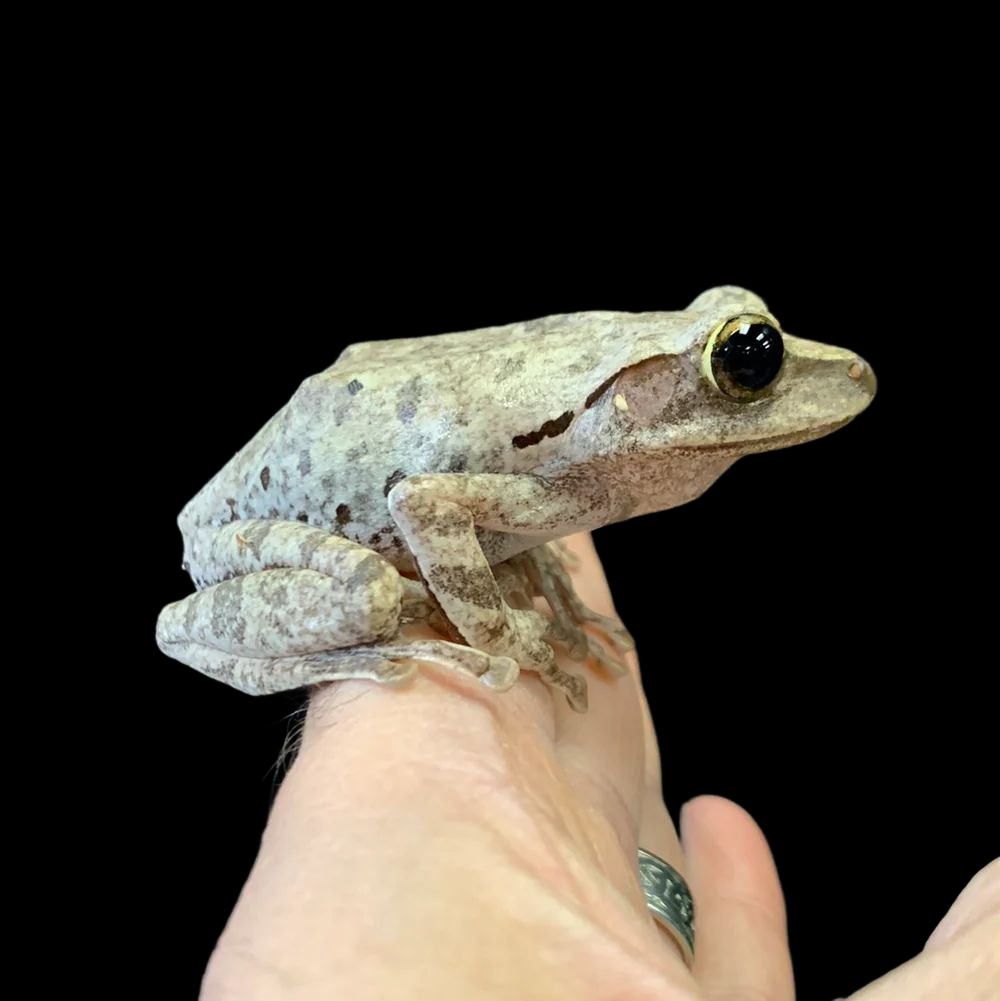
Foam Nest Tree Frog
Scientific Name: Polypedates leucomystax
Common Name: Foam Nest Tree Frog, Common Tree Frog, Four-lined Tree Frog
Species Overview
Size: Adults typically reach 2 to 3 inches (5 to 7.5 cm), with females slightly larger.
Appearance: The Foam Nest Tree Frog is a slender, smooth-skinned arboreal species with highly variable colouration. Individuals may appear tan, yellow, golden brown, olive, or pale green, often displaying faint stripes, marbling, or speckling. Some exhibit four subtle dorsal lines, while others are nearly patternless. Long limbs, lightweight bodies, and broad toe pads support impressive leaping ability.
Distribution: Widespread throughout Southeast Asia, including Thailand, Malaysia, Indonesia, the Philippines, Vietnam, Cambodia, Laos, and Myanmar.
Habitat: Wild individuals occupy diverse environments such as lowland forests, plantations, mangroves, agricultural areas, gardens, and human settlements. They generally remain near ponds, ditches, and seasonal pools used for foam-nest breeding.
Behaviour: Primarily nocturnal, they rest in foliage during the day and become active after dark to forage and call. They are prolific breeders, creating foam nests above water where eggs develop safely. Adaptable, agile, and resilient, they thrive in a wide variety of humid habitats.
Captive Care
Enclosure: A single adult or small group thrives in an 18 × 18 × 24 inches (45 × 45 × 60 cm) enclosure, while larger groups benefit from a 24 × 18 × 24 inches (60 × 45 × 60 cm) setup. Provide vertical climbing structures such as bamboo, branches, and cork flats, along with dense foliage. Use a moisture-retentive substrate such as coco fibre, soil blends, or sphagnum mixes to maintain humidity while ensuring proper drainage. A shallow water basin large enough for soaking should be included.
Temperature and Humidity:
Ambient temperature: 75 to 82°F (24 to 28°C)
Warm area: 84 to 86°F (29 to 30°C)
Night temperature: 70 to 74°F (21 to 23°C)
Humidity: 60 to 80%, achieved through regular misting and strong airflow.
Lighting: Provide low to moderate UVB (2 to 5%) with bright, diffused lighting.
Diet: Offer small to medium insects including crickets, roaches, black soldier fly larvae, silkworms, and occasional waxworms. Supplement all prey with calcium and multivitamins.
Behaviour in Captivity: Foam Nest Tree Frogs adapt very well to terrarium life. They are energetic jumpers, bold nocturnal feeders, and thrive in setups with tall foliage and secure perches. Handling should be kept to a minimum.
Special Considerations:
• Handle only if necessary, using wet, powder-free gloves or a soft, damp net.
• Provide sturdy branches—this species leaps forcefully and can knock over unstable décor.
• Maintain consistent humidity with proper ventilation to prevent stagnant air.
• Use only dechlorinated water for misting and hydration.
• Avoid oversaturating substrate; maintain a natural moisture cycle.
• Secure all enclosure gaps—this species is fast, agile, and an excellent climber.
Taxonomy Note
Polypedates leucomystax belongs to the family Rhacophoridae, a group recognised for its arboreal habits and foam-nesting reproductive strategy. This species complex is highly variable, with several regional forms representing distinct or semi-distinct lineages across Southeast Asia.
Genetics Note
There are no recognised morphs for Polypedates leucomystax. Natural colour and pattern variation is extensive across its range, but these differences do not constitute defined genetic morphs.
Estimate shipping