



Photo Disclaimer
Description
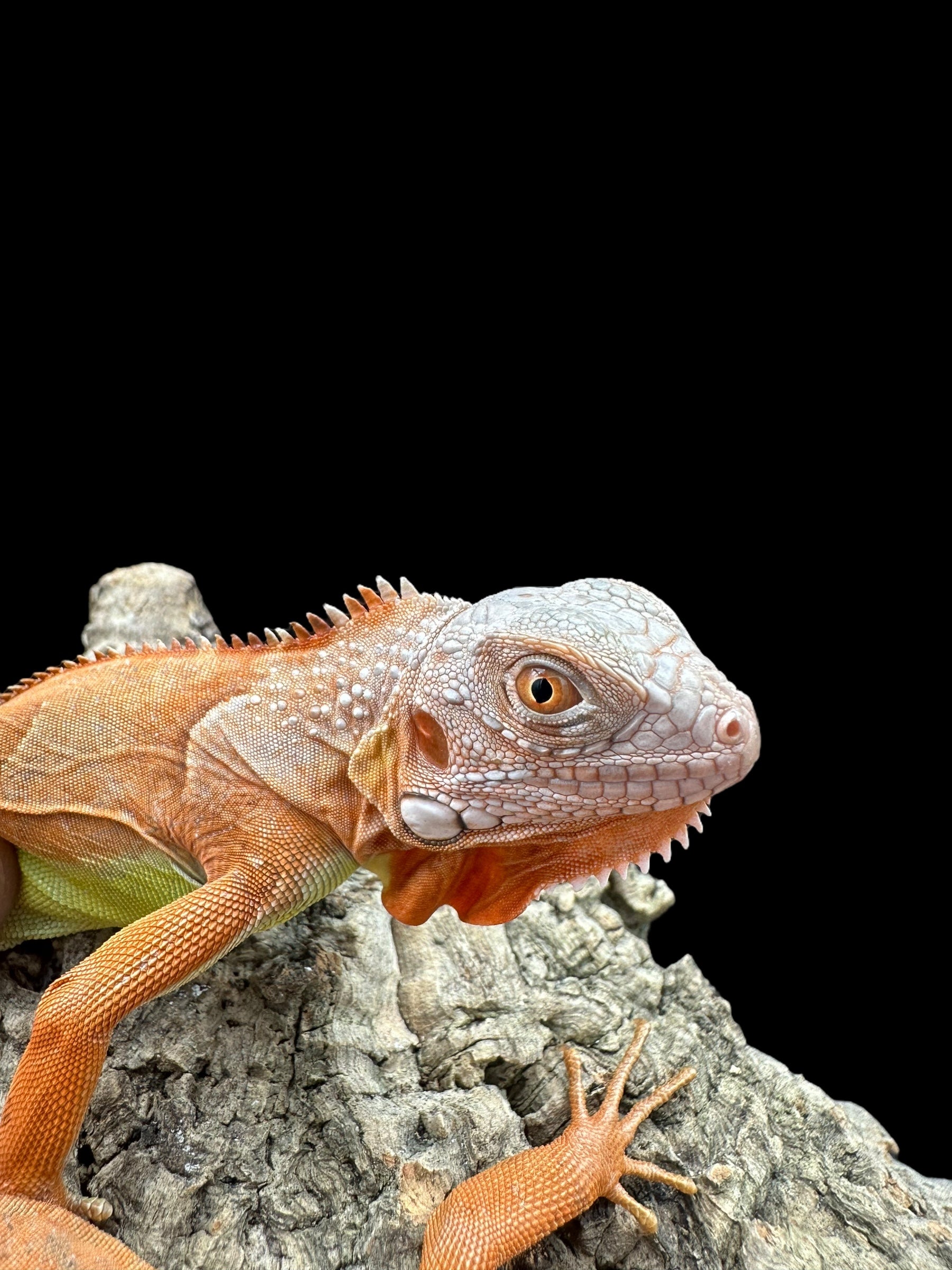
Green Iguana (Orange Zero)
Scientific Name: Iguana iguana
Common Name: Orange Zero Green Iguana
Species Overview
Size: Adults typically reach 4 to 6 feet (1.2 to 1.8 m) in length, with large males sometimes exceeding this range. Their tail makes up more than half their total length.
Appearance: The Orange Zero phase combines intense orange pigmentation with significantly reduced patterning. Individuals often display vivid orange, tangerine, or sunset tones across the body, dewlap, and dorsal spines. The Zero trait reduces or removes darker markings, creating a smooth, uniform appearance. Some may show light cream or soft grey highlights due to reduced contrasting pigment. Overall structure remains typical for the species, featuring tall dorsal spines, a prominent dewlap, muscular limbs, and a long, powerful tail.
Distribution: Green Iguanas are native to Central and South America, including Mexico, Belize, Guatemala, Honduras, Nicaragua, Costa Rica, Panama, Colombia, Venezuela, Ecuador, and Brazil.
Habitat: Green Iguanas inhabit humid tropical forests, mangroves, and riverbank canopy systems. They rely on tall trees for basking, feeding, and escaping predators.
Behaviour: Green Iguanas are diurnal, arboreal, and herbivorous. They bask extensively, display territorial behaviours such as head-bobbing and dewlap extension, and use tail-whipping defensively. Mature males may become more territorial during breeding seasons.
Captive Care
Enclosure: Provide a tall arboreal enclosure at least 8 feet × 4 feet × 4 feet (2.4 × 1.2 × 1.2 m), with larger custom enclosures ideal for adults. Furnish with heavy branches, elevated platforms, vines, and dense foliage to support climbing and security.
Temperature and Humidity:
Basking area: 100 to 105°F (38 to 40°C)
Warm side: 90 to 95°F (32 to 35°C)
Cool side: 78 to 82°F (26 to 28°C)
Night temperatures: 72 to 75°F (22 to 24°C)
Humidity should remain between 60 and 80 percent using daily misting and deep water dishes.
Lighting: Provide strong full-spectrum lighting and high-output UVB (10 to 12 percent). Bright lighting helps display the full depth of orange pigment.
Diet: Offer a herbivorous diet including leafy greens, edible flowers, bell peppers, squash, green beans, prickly pear cactus pads, and limited fruits. Avoid high-oxalate vegetables. Provide regular calcium supplementation.
Behaviour in Captivity: Green Iguanas are active, intelligent, and visually alert. They adapt well to consistent routines and large, enriching enclosures. Handling tolerance varies widely between individuals and improves with calm, steady interaction.
Special Considerations:
• Ensure strong, secure climbing structures due to the species’ size and strength.
• Bright colouration may intensify with age, basking temperature, and seasonal changes.
• Maintain strong UVB exposure to support long-term health.
• Provide a mix of shaded and bright areas for natural thermoregulation.
Taxonomy Note
Green Iguanas belong to the family Iguanidae, a diverse group of herbivorous New World lizards. Iguana iguana is highly adaptable and widely distributed across tropical regions. The Orange Zero phase is a selectively bred colour and pattern variant, not a separate subspecies.
Genetics Note
Orange (polygenic): Selective line breeding enhances orange pigmentation across the body. Expression varies among individuals and may strengthen with maturity, basking, and seasonal shifts.
Zero (recessive or line-bred): Produces reduced or absent patterning, creating a clean, uniform appearance. Expression strength varies by lineage.
Combined Expression: The Orange Zero combination results in a vivid, patternless appearance that intensifies under strong lighting and during growth.