
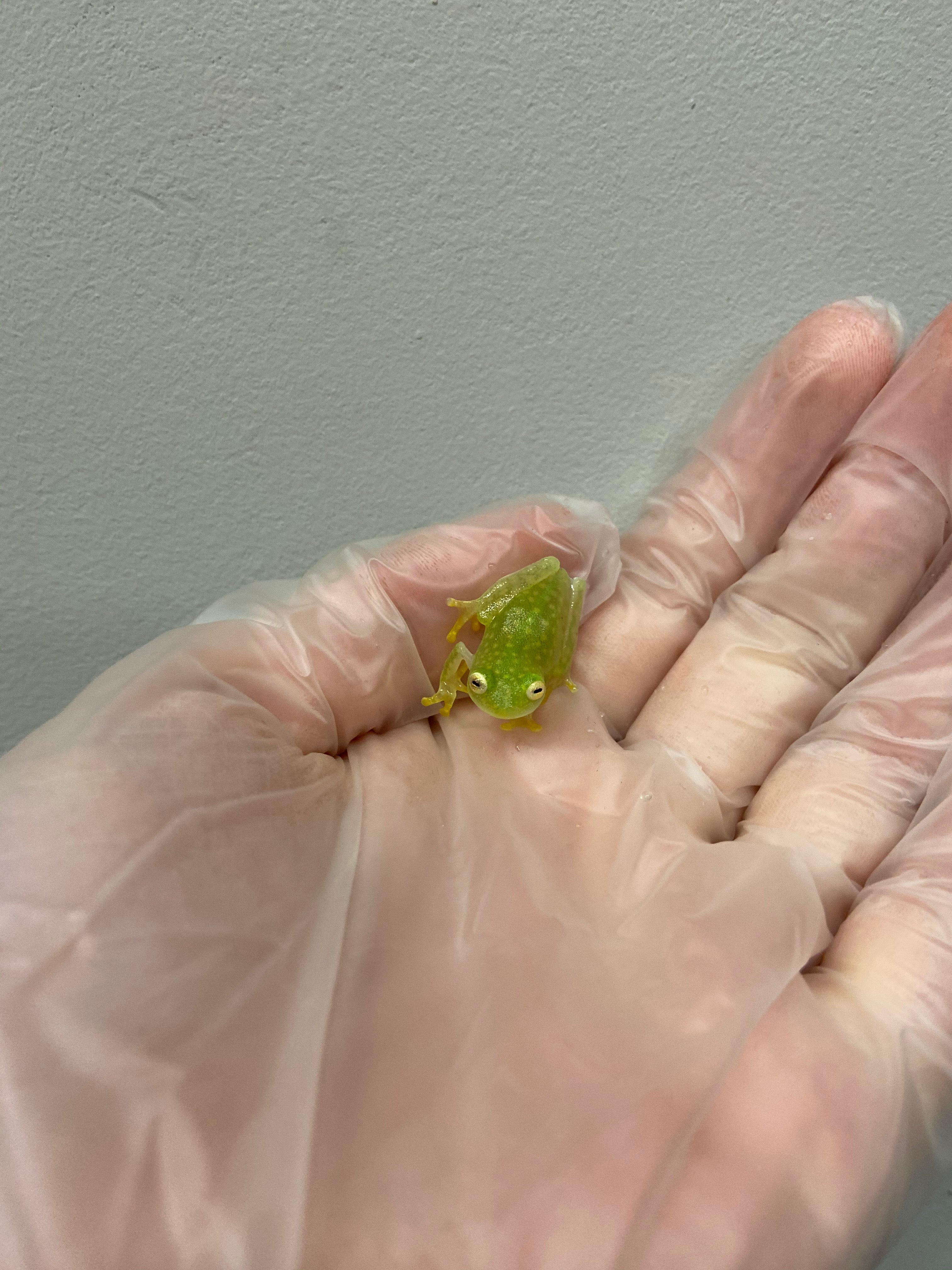
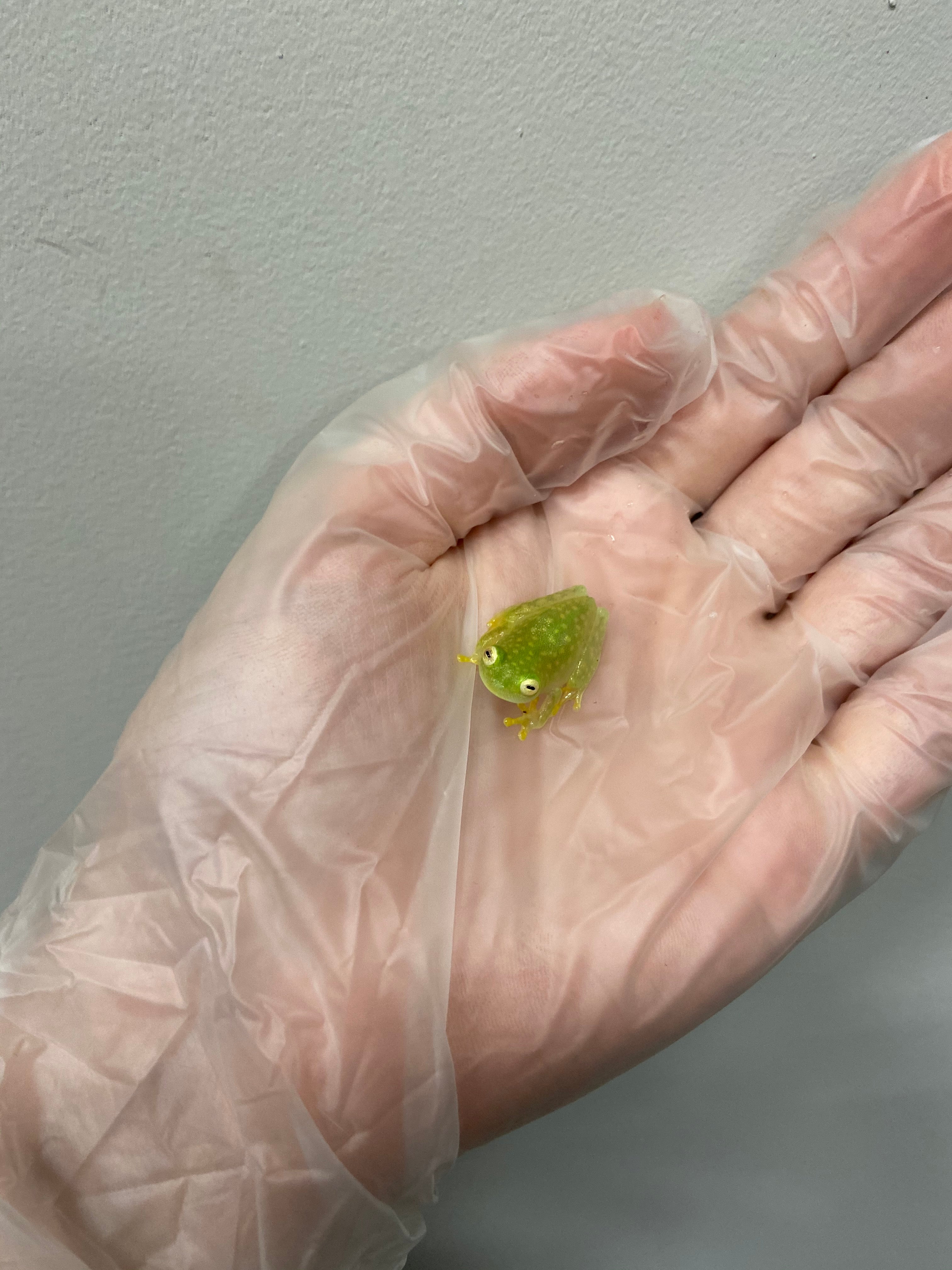
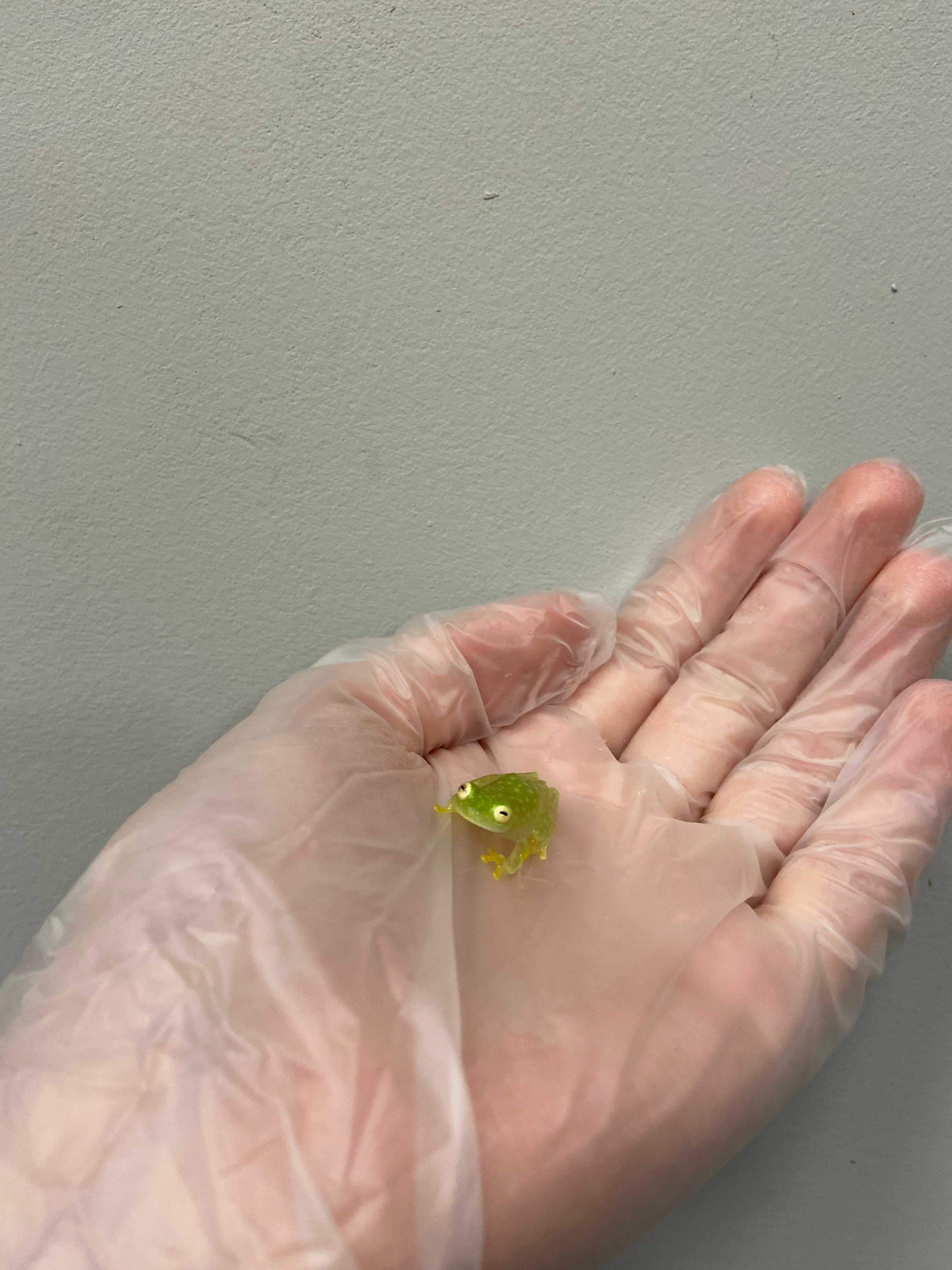


Photo Disclaimer
Description
Fleischmann's Glass Frog
Scientific Name: Hyalinobatrachium fleischmanni
Common Name: Fleischmann's Glass Frog, Northern Glass Frog
Species Overview
Size: Adults typically reach 1 to 1.25 inches (2.5 to 3 cm), with females slightly larger.
Appearance: Fleischmann's Glass Frog is a delicate, semi-translucent species with a lime-green dorsum sprinkled with tiny yellow or white spots. The ventral surface is partially transparent, revealing internal organs, a hallmark of true glass frogs. Skin is smooth, and the body is slender with long limbs and small, rounded toe pads. Eyes are large, forward-facing, and silvery-white with horizontal pupils, giving the frog a distinctive alert expression.
Distribution: Found from southern Mexico through Central America into northern South America, including Costa Rica, Panama, Nicaragua, Honduras, Colombia, and Ecuador.
Habitat: Wild individuals inhabit humid lowland and mid-elevation rainforests, often near streams, rivers, and waterfalls. They are strongly associated with riparian vegetation, where males guard eggs laid on the underside of leaves above running water.
Behaviour: Primarily nocturnal, these frogs perch on leaves overhanging water and remain motionless when disturbed. Males call softly at night and exhibit parental care by guarding egg clutches. They are shy, sensitive, and highly adapted to stable humidity and gentle airflow.
Captive Care
Enclosure: A single adult or small group thrives in a 12 × 12 × 18 inches (30 × 30 × 45 cm) enclosure, while larger groups benefit from an 18 × 18 × 24 inches (45 × 45 × 60 cm) setup. Provide abundant leafy perches—especially broad, smooth leaves—and branches positioned above water features. Use a moisture-retentive substrate such as coco fibre, soil blends, or sphagnum to maintain high humidity. Include a wide, shallow water basin or a gentle running-water feature to replicate natural streamside conditions.
Temperature and Humidity:
Ambient temperature: 72 to 78°F (22 to 26°C)
Warm area: up to 80°F (27°C)
Night temperature: 68 to 72°F (20 to 22°C)
Humidity: 80 to 100%, maintained through frequent misting, dense foliage, and excellent moisture retention.
Lighting: Provide low UVB (around 2%) with soft, diffused lighting. Avoid bright or hot light—this species prefers shaded conditions.
Diet: Offer very small insects such as fruit flies, small crickets, springtails, isopods, and tiny roaches. Supplement prey with calcium and multivitamins.
Behaviour in Captivity: Glass frogs thrive in cool, humid, densely planted terrariums with abundant leaf cover. They remain shy and rarely tolerate disturbance. Most activity occurs at night, especially when humidity rises. Handling should be strictly avoided.
Special Considerations:
• Handle only if absolutely necessary, using wet, powder-free gloves or a soft, damp net—never bare hands.
• Maintain high humidity with strong ventilation; stagnant, saturated air is harmful.
• Provide broad leaves placed over water features to mimic natural calling and resting sites.
• Keep temperatures cool and avoid warm hotspots.
• Use only clean, dechlorinated water for misting and for any water features.
• Seal enclosure gaps carefully—this tiny species can escape through small openings.
Taxonomy Note
Hyalinobatrachium fleischmanni belongs to the family Centrolenidae, the true glass frogs. Members of this genus are characterised by forward-facing eyes, transparent ventral surfaces, and reproductive behaviour tied to running water. This species is one of the most widespread and commonly studied glass frogs.
Genetics Note
There are no recognised morphs for Hyalinobatrachium fleischmanni. Natural variation occurs in dorsal spot density, translucency level, and green colour tone, but none represent defined genetic morphs.
Estimate shipping