

Photo Disclaimer
Description
Purple Harlequin Toad
Scientific Name: Atelopus barbotini
Common Name: Purple Harlequin Toad
Species Overview
Size: Adults typically reach 1.2 to 1.8 inches (3 to 4.5 cm), with females slightly larger and more robust than males.
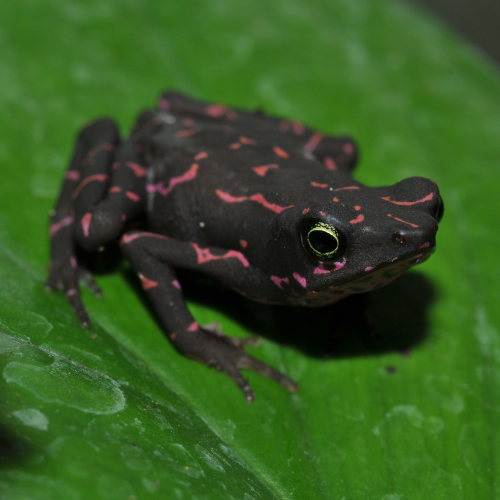
Appearance: The Purple Harlequin Toad is one of the most striking members of the Atelopus genus, displaying vivid colouration that ranges from deep violet and plum tones to lighter lavender or bluish hues. These colours contrast sharply with black or very dark spotting or reticulated patterning across the body and limbs. The skin is smooth and glossy rather than warty. The body is slender and angular, with long, delicate limbs adapted for agile movement along rocks and stream edges. The underside is typically pale with minimal patterning. Their appearance is highly variable but always visually dramatic.
Distribution: Endemic to French Guiana, with populations restricted to specific upland rainforest regions and clear mountain streams.
Habitat: Wild individuals inhabit pristine tropical rainforests along fast-flowing, high-elevation streams. They prefer mossy rocks, leaf litter, and humid forest-floor microhabitats near very clean water. Their survival is closely tied to cool, well-oxygenated stream systems. In captivity, they are extremely challenging to keep due to narrow environmental requirements.
Behaviour: Diurnal and highly alert, Purple Harlequin Toads move quickly over rocks and moist substrate. They are social among their own species, often seen in small aggregations in nature. They rely on bright warning colours rather than camouflage and produce mild skin toxins. Their behaviour is active but delicate, making them sensitive to environmental changes.
Captive Care
Enclosure: A single adult can be housed in an 18 × 18 × 18 inches (45 × 45 × 45 cm) enclosure. Provide strong ventilation, high humidity, and a cool-running water feature or drip system to approximate mountain stream conditions. Use a substrate of moss, soil, and leaf litter, with smooth rocks, cork flats, and dense live plants for climbing and cover. For groups, an upgrade to 24 × 18 × 18 inches (60 × 45 × 45 cm) is recommended to avoid crowding and to provide more environmental stability. Clean, cool water and consistent maintenance are essential.
Temperature and Humidity:
Ambient temperature: 68 to 74°F (20 to 23°C)
Warm area: 75°F (24°C)
Night temperature: 62 to 68°F (17 to 20°C)
Humidity: 80 to 100%, with excellent airflow to prevent stagnant, unhealthy conditions. Substrate should remain consistently moist but not waterlogged.
Lighting: Provide low-level UVB (2 to 5%) and bright but diffused lighting to support diurnal activity and plant growth. Avoid heat-heavy lighting setups.
Diet: Offer small, frequent prey such as fruit flies, pinhead crickets, springtails, and tiny worms. Supplement insects with calcium and vitamins. Due to their small size and rapid metabolism, regular feeding is important.
Behaviour in Captivity: Highly sensitive and delicate, these toads require stable, cool, humid conditions and minimal disturbance. When well cared for, they are active, visually stunning, and engaging to observe. Handling should be avoided entirely.
Genetics Note
There are no recognised morphs for the Purple Harlequin Toad. Natural variation occurs in purple intensity and the size or distribution of dark markings, but these differences reflect normal population diversity rather than morph-based genetics.