

Photo Disclaimer
Description
Russian Tortoise
Scientific Name: Testudo horsfieldii
Common Name: Russian Tortoise, Horsfield’s Tortoise, Central Asian Tortoise
Species Overview
Size: Males typically reach 5 to 6 inches (13 to 15 cm), while females grow larger at 6 to 8 inches (15 to 20 cm).
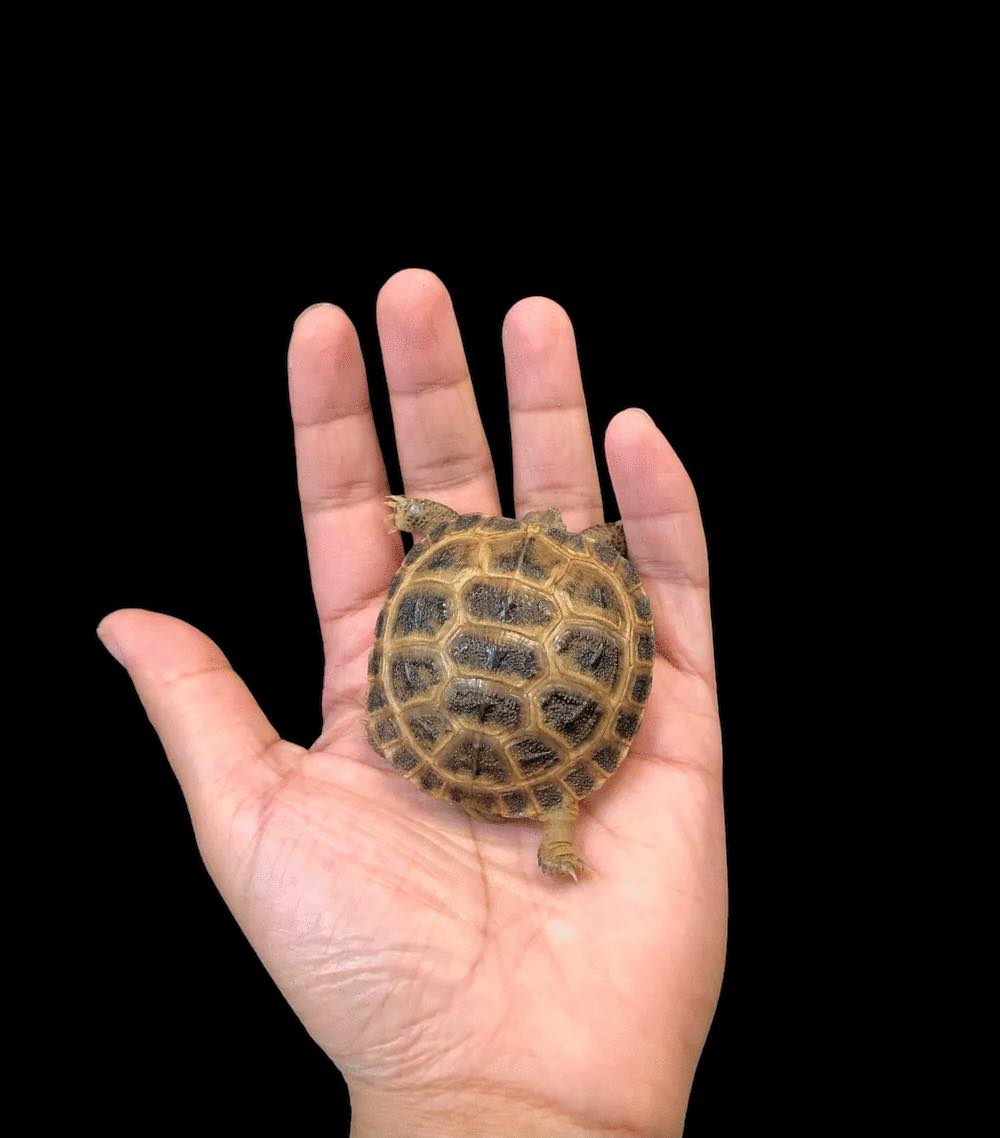
Appearance: The Russian Tortoise has a round, flattened carapace ranging from sandy yellow to olive or tan with darker brown blotches across each scute. The shell is relatively smooth with minimal doming, adapted for manoeuvring in tight burrows. The plastron is pale with varying dark patches. Limbs are sturdy and covered in coarse scales, well-suited for digging. The species’ most distinctive trait is its four toes on each front foot. Males have longer tails and a slight plastral concavity, while females are broader and larger-bodied.
Distribution: Native to Central Asia, including Uzbekistan, Turkmenistan, Kazakhstan, Afghanistan, and northern Iran.
Habitat: In nature, Russian Tortoises inhabit arid deserts, dry grasslands, scrublands, and rocky foothills. They experience extreme temperature shifts and rely heavily on burrows for thermoregulation. In captivity, they require a warm, dry enclosure with deep substrate for digging and access to shaded retreats.
Behaviour: Russian Tortoises are diurnal, hardy, and active grazers. They are enthusiastic diggers and spend much of their time exploring or burrowing. When provided proper space and dry conditions, they become confident, outgoing, and highly food-motivated.
Captive Care
Enclosure: Provide a minimum indoor enclosure of 4 × 2 feet (120 × 60 cm) for one adult, though larger is strongly recommended due to their high activity level. Use a dry soil–sand mixture deep enough for digging. Include hides, rocks, logs, and open areas for roaming. Outdoor enclosures are ideal in warm, dry climates and greatly benefit long-term health.
Temperature and Humidity:
Ambient daytime: 80 to 88°F (27 to 31°C)
Basking area: 95 to 100°F (35 to 38°C)
Night temperature: 65 to 72°F (18 to 22°C)
Humidity: Low overall, around 20 to 40%, with slightly higher humidity in deep burrows.
Lighting: Provide full-spectrum lighting with 10–12% UVB to support healthy shell development and proper metabolic function. Ensure a strong basking spot alongside shaded cooling areas.
Diet: Offer a high-fibre, low-protein herbivorous diet including grasses, edible weeds, dandelion, plantain, clover, collard greens, and other fibrous vegetation. Avoid fruits, high-moisture vegetables, and protein-rich foods. Flowers such as hibiscus, rose petals, and nasturtiums can be offered regularly.
Behaviour in Captivity: Russian Tortoises thrive in large, naturalistic, dry setups. They enjoy burrowing, climbing, grazing, and exploring. They adapt quickly to routine care and are among the most active tortoise species when kept properly.
Special Considerations
• Requires dry conditions—avoid excessive humidity.
• Deep substrate is essential for burrowing behaviour and comfort.
• Highly active—needs more space than similarly sized tortoises.
• Outdoor housing is ideal when climate permits.
Taxonomy Note
Testudo horsfieldii is the only four-toed member of the Testudo genus. Several locality forms exist across Central Asia, differing slightly in size, colouration, and shell shape.
Genetics Note
There are no recognised morphs for the Russian Tortoise. Differences in shell tone, mottling, and overall body shape reflect natural regional and individual variation rather than selective breeding.