

Photo Disclaimer
Description
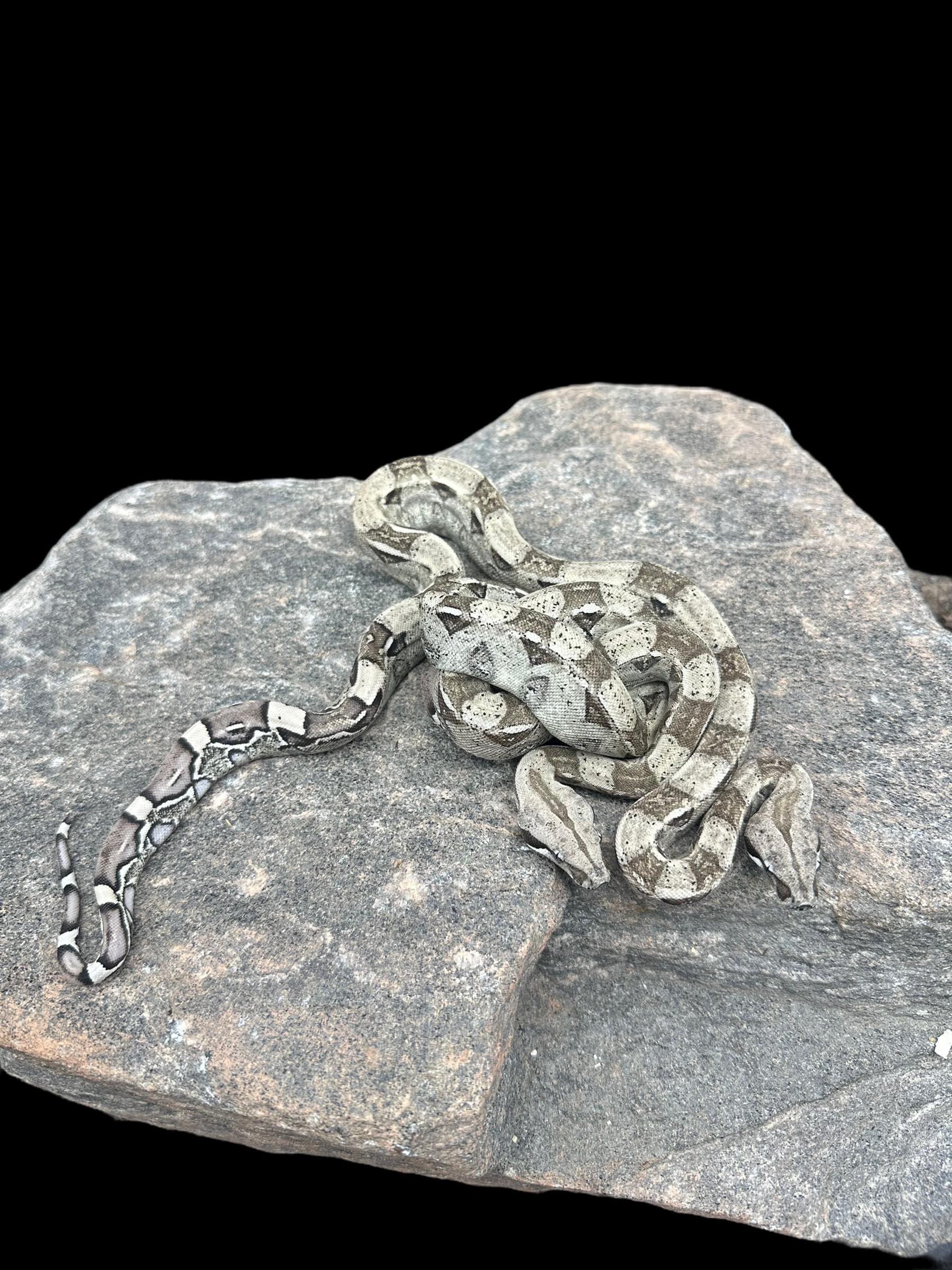
B.C.I (Anery Het Kahl Snow)
Scientific Name: Boa constrictor imperator
Common Name: B.C.I, Anery Het Kahl Snow
Species Overview
Size: Adults typically reach 6–8 feet (1.8–2.4 m) in length, with females generally larger than males. Adult weight ranges from 15–30 pounds, depending on genetics and husbandry.
Appearance: This morph combines the Anerythristic pattern with a hidden Kahl Albino gene. Anery removes red pigment, producing shades of gray, silver, and black. Het Kahl Albino indicates the boa carries but does not visually express the Kahl Albino gene, which influences pattern contrast and coloration when combined with other genes.
Distribution: Native to Central and South America, ranging from Mexico through Colombia.
Habitat: Occupies tropical lowlands and semi-arid regions, often near rivers, forest edges, and savannahs.
Behaviour: Primarily nocturnal ambush predators, feeding on small mammals, birds, and reptiles. Excellent swimmers and climbers, though adults are mostly terrestrial.
Captive Care
Enclosure: A naturalistic setup is strongly recommended. Adults should have at least a 6′ × 2′ × 2′ (183 × 61 × 61 cm) enclosure with sturdy branches, hides, cork bark, and plant cover. Bioactive environments with soil substrate, leaf litter, and live plants help maintain humidity and provide enrichment.
Temperature and Humidity: Maintain a gradient of 80–85°F (27–29°C), with a basking spot of 88–92°F (31–33°C). Nighttime can drop to 75–78°F (24–26°C). Humidity should remain between 55–70%, with access to a water dish large enough for soaking.
Lighting: Standard ambient lighting is sufficient. Low-level UVB is optional but can benefit live plants in naturalistic setups.
Diet: Juveniles feed every 7–10 days on appropriately sized rodents; adults feed every 14–21 days on larger prey items.
Behaviour in Captivity: Hardy and generally tolerant of handling. With consistent, calm husbandry, most individuals become manageable pets.
Special Considerations: Due to their potential adult size of 6–8 feet (1.8–2.4 m), it is important to plan for appropriate future housing. Handling large adults can be challenging; having a second person assist can improve safety and reduce stress for both the snake and keeper.
Taxonomy Note
Boa constrictor imperator is a member of the family Boidae, a group of non-venomous constricting snakes native to the Americas. Formerly classified as a subspecies of Boa constrictor, B. imperator is now widely recognised as a distinct species based on genetic, morphological, and geographic evidence, with a natural range spanning much of Central America and extending into parts of northern South America. In captivity, this species is valued for its adaptability, generally steady temperament, and extensive diversity of selectively bred colour and pattern traits, all of which retain consistent core behaviours and care requirements across standard B.C.I forms.
Genetics Note
Anerythristic (Recessive): The Anery gene removes red pigmentation, producing greys, blacks, and whites. Animals must inherit two copies to visually express the Anery phenotype, while single-copy carriers do not show visually but can pass the gene to offspring.
Het Kahl Albino (Recessive Carrier): This snake carries one copy each of the Kahl and Albino genes. Kahl modifies pattern and contrast when expressed in two copies, and Albino removes black pigmentation, producing red, orange, and yellow tones when expressed in two copies. As a single-copy carrier, the snake is visually normal but can pass both genes to offspring.