

Photo Disclaimer
Description
Bird Voice Tree Frog
Scientific Name: Dryophytes avivoca
Common Name: Bird Voice Tree Frog
Species Overview
Size: Adults typically reach 1.25 to 2 inches (3 to 5 cm), with females slightly larger.
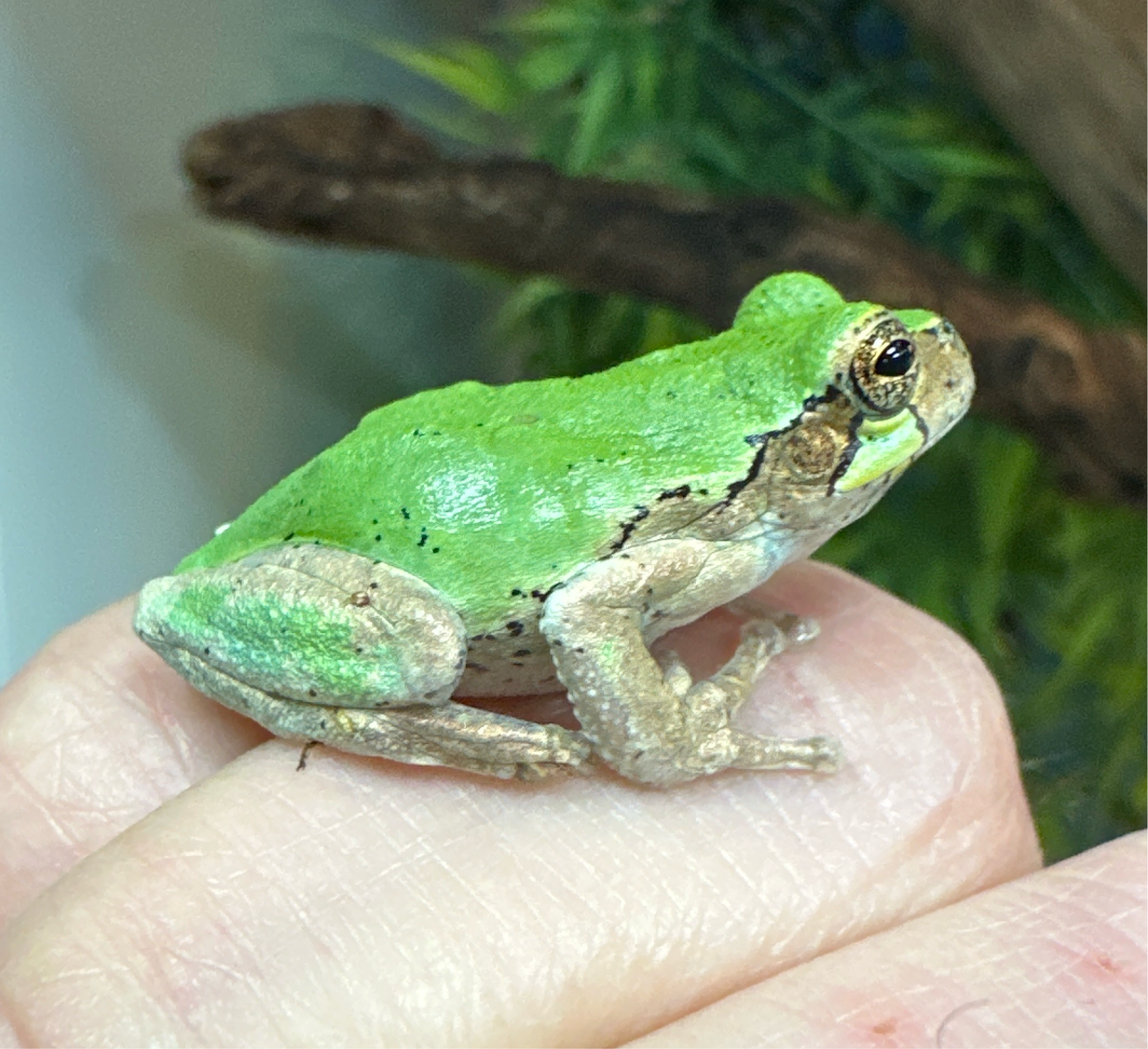
Appearance: The Bird Voice Tree Frog is a slender, smooth-skinned arboreal species with colouration ranging from soft green to grey or brown, often shifting based on temperature, humidity, or stress. Some individuals display faint mottling, while others appear nearly uniform. Their toe pads are wide and adhesive, and the eyes are golden to bronze with horizontal pupils. Their delicate, streamlined build distinguishes them from more robust North American hylids.
Distribution: Native to the southeastern United States, including Louisiana, Mississippi, Alabama, Georgia, Tennessee, and Arkansas.
Habitat: Wild individuals inhabit moist woodlands, cypress swamps, shrublands, and areas near slow-moving water. They often perch on reeds, shrubs, or low vegetation above breeding ponds.
Behaviour: Primarily nocturnal, these frogs are agile climbers and subtle in movement. Males produce a clear, bird-like whistle that gives the species its name. They conceal themselves in foliage during the day and become active at dusk.
Captive Care
Enclosure: A single adult or small group thrives in an 18 × 18 × 24 inches (45 × 45 × 60 cm) enclosure, while larger groups benefit from a 24 × 18 × 24 inches (60 × 45 × 60 cm) setup. Provide vertical climbing structure such as branches, reeds, cork bark, and dense vegetation. Use a moisture-retentive substrate such as coco fibre, soil blends, or sphagnum mixes to support humidity without becoming waterlogged. Include a shallow water basin for hydration.
Temperature and Humidity:
Ambient temperature: 74 to 80°F (23 to 27°C)
Warm area: 82 to 84°F (28 to 29°C)
Night temperature: 65 to 72°F (18 to 22°C)
Humidity: 60 to 80%, maintained through regular misting and good airflow.
Lighting: Provide low to moderate UVB (2 to 5%) with bright, diffused lighting. Avoid excessive heat.
Diet: Offer small insects such as fruit flies, crickets, bean beetles, small roaches, and black soldier fly larvae. Supplement all prey with calcium and multivitamins.
Behaviour in Captivity: Bird Voice Tree Frogs adapt well to tall, planted terrariums. They hide within dense foliage during the day and become active at night. They are sensitive frogs, so handling should be minimal.
Special Considerations:
• If handling is unavoidable, use wet, powder-free gloves or a soft, damp net.
• Ensure strong ventilation to prevent stagnant humidity and skin issues.
• Use only dechlorinated water for misting and drinking sources.
• Provide narrow perches and dense vegetation to mimic natural microhabitats.
• Avoid oversaturation of substrate; maintain humidity without waterlogging.
• Keep the enclosure escape-proof—this species is small, agile, and can exploit gaps.
Taxonomy Note
The Bird Voice Tree Frog belongs to the family Hylidae and genus Dryophytes, a group of North American tree frogs distinguished by their adhesive toe pads and varied calls. Dryophytes avivoca is closely related to the Green Tree Frog (Dryophytes cinereus) but is smaller, more delicate, and recognised by its distinctive bird-like vocalisation.
Genetics Note
There are no recognised morphs for Dryophytes avivoca. Natural variation occurs in dorsal colour tone and subtle patterning, but these differences do not represent defined genetic morphs.