

Photo Disclaimer
Description
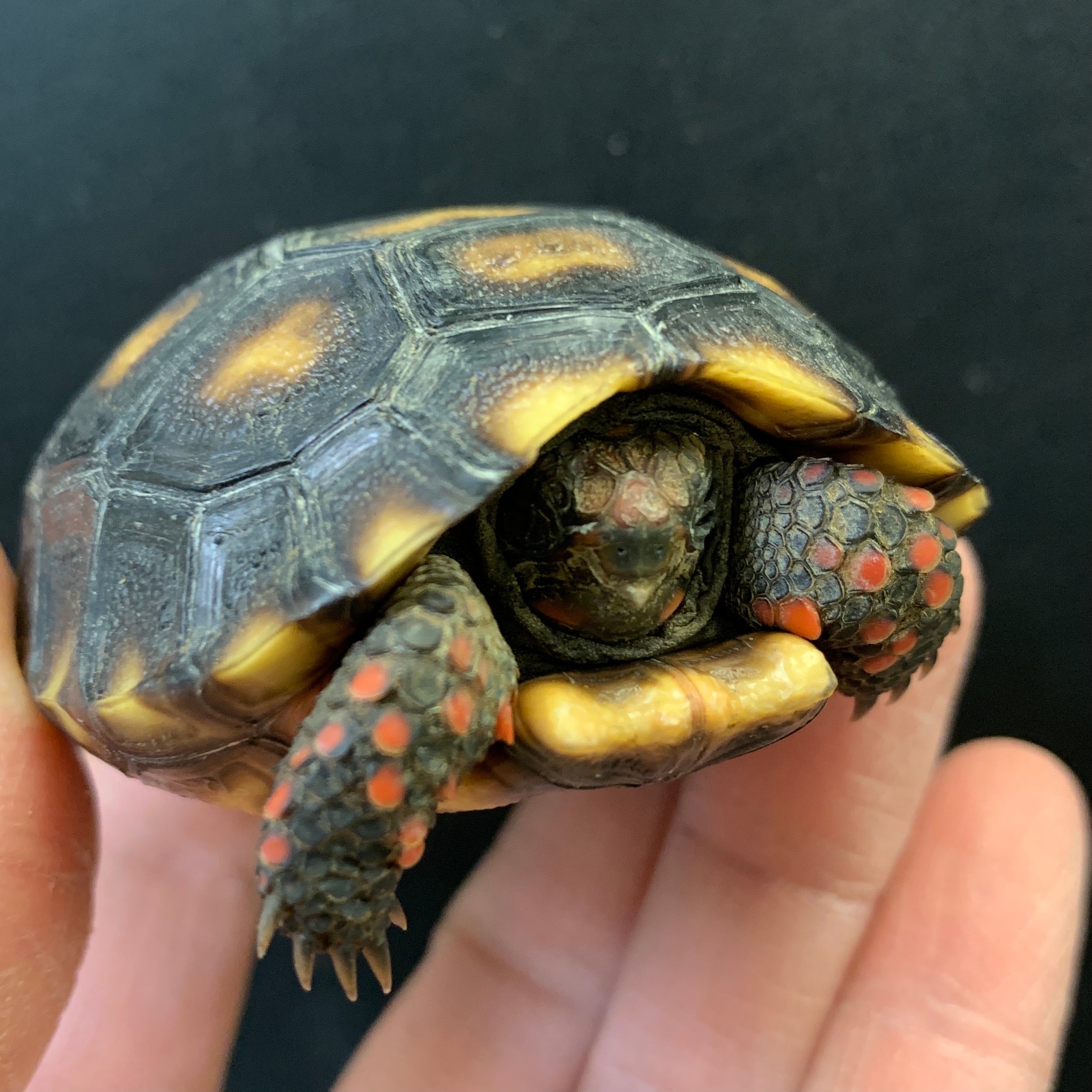
Cherry Head Tortoise
Scientific Name: Chelonoidis carbonarius
Common Name: Cherry Head Tortoise, Cherry Head Red-footed Tortoise
Species Overview
Size: Males typically reach 10 to 12 inches (25 to 30 cm), while females grow larger at 12 to 14 inches (30 to 36 cm).
Appearance: The Cherry Head Tortoise is a vibrant regional form of the Red-footed Tortoise, known for its bright red or orange head and limb scales. The carapace is dark brown to nearly black with lighter yellow or tan centres on each scute, typically slightly domed and elongated. Cherry Heads often have more intense facial coloration, smoother shells, and a more compact shape than broader Red-footed populations.
Distribution: Originates from coastal and humid forest regions of Brazil, where conditions remain warm and consistently moist year-round.
Habitat: In the wild, this tortoise inhabits tropical forests, forest edges, and humid scrublands. It spends much of its time within leaf litter, shaded understory growth, and near fallen logs. In captivity, they require a humid, warm setup with plenty of cover and a deep, moisture-retentive substrate.
Behaviour: Cherry Head Tortoises are active, inquisitive, and often bold feeders. They spend long periods exploring their environment, foraging, and moving between humid hiding spots and warmer open zones.
Captive Care
Enclosure: Provide an indoor enclosure with a minimum footprint of 6 × 3 feet (180 × 90 cm) for one adult. Use a deep soil-based substrate that retains moisture and allows natural digging. Include hides, logs, plants, and shaded regions. Outdoor housing is beneficial during warm months above 75°F (24°C) when humidity remains high.
Temperature and Humidity:
Ambient daytime: 80 to 86°F (27 to 30°C)
Basking area: 92 to 95°F (33 to 35°C)
Night temperature: 72 to 75°F (22 to 24°C)
Humidity: 70 to 90%, maintained with misting, humid hides, and deep substrate.
Lighting: Provide full-spectrum lighting with 10–12% UVB to support proper shell growth and metabolism. Ensure the enclosure includes both a clear basking zone and shaded retreat areas.
Diet: Offer a varied omnivorous diet including leafy greens, edible weeds, vegetables, fungi, insects, and fruits in moderation. Cherry Heads naturally consume a higher proportion of fruit than many tortoise species, but it should still remain limited to approximately 10–20% of the overall diet.
Behaviour in Captivity: These tortoises adjust well to complex, humid enclosures. They are enthusiastic foragers, display natural digging behaviours, and remain active throughout the day when humidity and temperature are stable.
Special Considerations
• Consistently high humidity is critical to prevent pyramiding and respiratory issues.
• Provide humid shelters as well as warm basking areas.
• Outdoor housing in suitable weather improves activity and enrichment.
• Substrate must be deep and moisture-retentive to support burrowing.
Taxonomy Note
The Cherry Head Tortoise is a locality form of the Red-footed Tortoise (Chelonoidis carbonarius). Although not a separate subspecies, it is recognised for its distinct coloration, smaller adult size, and specific Brazilian origin.
Genetics Note
Cherry Head Tortoises do not represent a selectively bred morph. Their bright head coloration, shell texture, and overall appearance reflect natural locality-based variation within the wider Red-footed Tortoise species.