

Photo Disclaimer
Description
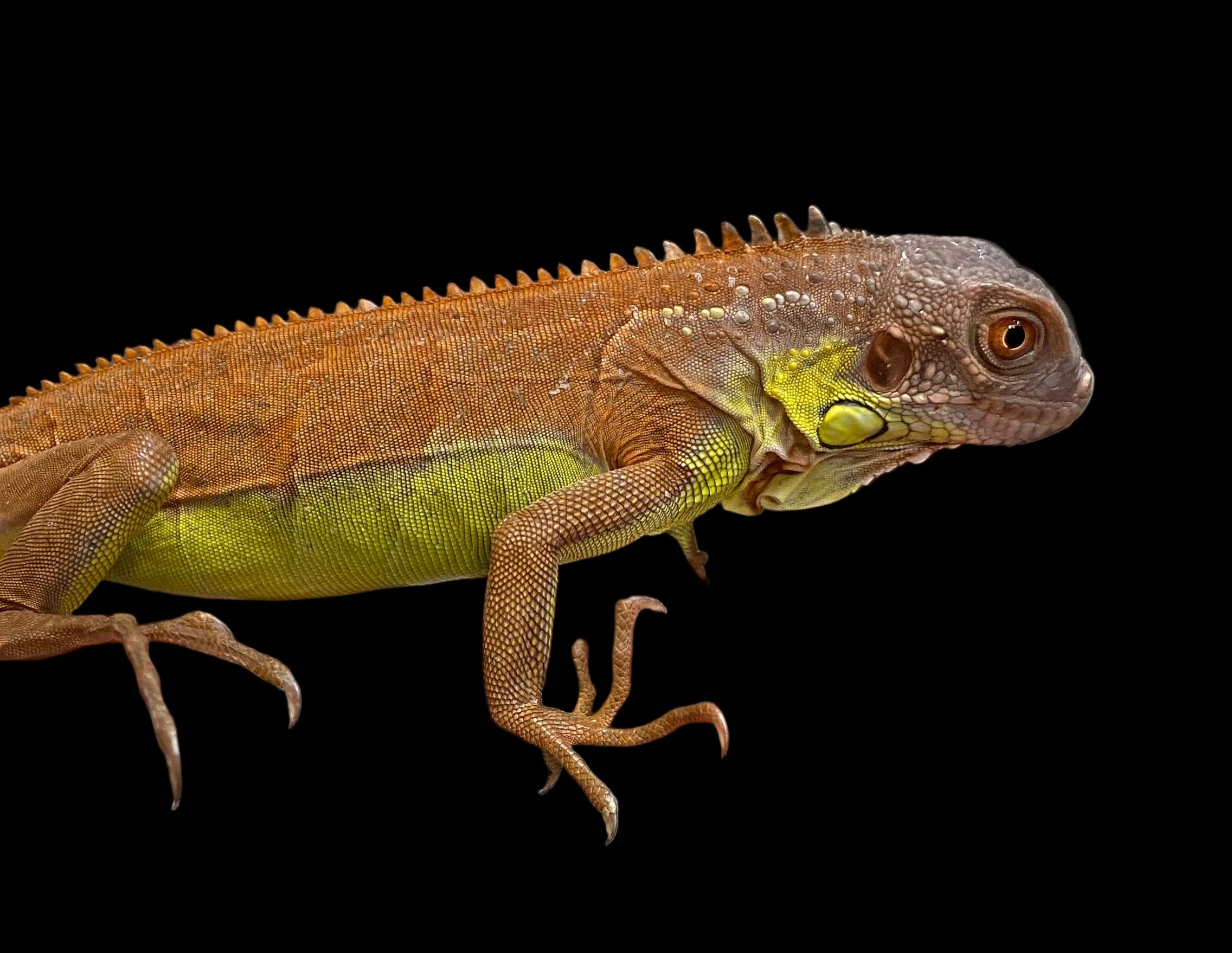
Green Iguana (Translucent Phase)
Scientific Name: Iguana iguana
Common Name: Translucent Phase Green Iguana
Species Overview
Size: Adults generally reach 4 to 6 feet (1.2 to 1.8 m) in total length, with large males occasionally exceeding this range. Their long tail accounts for more than half their overall length.
Appearance: The Translucent Phase Green Iguana displays partially transparent scaling, especially along the limbs, dewlap, and tail. This creates a softened, glassy appearance where underlying tissue tones subtly show through. Some individuals develop light blue, soft grey, or pastel hues, particularly around the head and dorsal spines. Eye colour may appear lighter or more reflective than in wild-type individuals. Structural features remain consistent with standard Green Iguanas, including tall dorsal spines, a large dewlap, muscular limbs, and a robust tail.
Distribution: Naturally distributed throughout Central and South America, including Mexico, Belize, Guatemala, Honduras, Nicaragua, Costa Rica, Panama, Colombia, Venezuela, Ecuador, and Brazil.
Habitat: Wild Green Iguanas inhabit tropical forests, canopy margins, riverbanks, and mangroves. In captivity, Translucent individuals require similar arboreal environments with strong lighting and extensive climbing structures, though additional shaded spaces may benefit sensitive individuals.
Behaviour: Diurnal and arboreal, Green Iguanas spend much of their time basking and feeding on vegetation. They exhibit territorial behaviours such as dewlap extension, head-bobbing, and tail-whipping. The Translucent Phase does not alter temperament or instinctual behaviours.
Captive Care
Enclosure: Provide a large arboreal enclosure at least 8 feet × 4 feet × 4 feet (2.4 × 1.2 × 1.2 m), with larger enclosures strongly recommended for adults. Furnish with thick branches, elevated platforms, cork rounds, vines, and dense foliage to replicate their natural environment.
Temperature and Humidity:
Basking area: 100 to 105°F (38 to 40°C)
Warm side: 90 to 95°F (32 to 35°C)
Cool side: 78 to 82°F (26 to 28°C)
Night temperatures: 72 to 75°F (22 to 24°C)
Maintain humidity between 60 and 80 percent through regular misting and large water dishes.
Lighting: Provide strong full-spectrum lighting and high-output UVB (10 to 12 percent). Translucent individuals may benefit from slightly increased shaded retreats due to increased light sensitivity around thinner skin areas.
Diet: Offer a strict herbivorous diet consisting of leafy greens, edible flowers, bell peppers, squash, prickly pear cactus pads, green beans, and occasional fruits. Avoid high-oxalate vegetables. Calcium supplementation is essential, particularly for juveniles.
Behaviour in Captivity: These iguanas are intelligent, active, and visually responsive. With appropriate space and consistent routines, they adapt well. Handling tolerance varies greatly between individuals, and slow, consistent positive interactions support better socialization.
Special Considerations:
• Provide extra shaded foliage and hides to support comfort for individuals with thinner or lighter skin.
• Maintain strong UVB exposure while ensuring thermal gradients are accessible.
• Large, structurally secure enclosures are essential for this species.
• Monitor hydration and skin condition due to the more delicate appearance of the translucent scaling.
Taxonomy Note
The Green Iguana is a member of the family Iguanidae, a group of herbivorous and arboreal New World lizards. The Translucent Phase is produced through selective captive breeding and does not represent a distinct subspecies.
Genetics Note
Translucent (recessive): This recessive gene causes reduced pigmentation and partially transparent scaling, especially along the limbs and tail. Visual Translucent individuals exhibit the characteristic glassy shine and thinner skin areas.
Natural variation: Some Translucent Iguanas show stronger blue or grey tones, while others remain pale or pastel. These differences reflect natural variation within the expression of the Translucent gene.
Estimate shipping