

Photo Disclaimer
Description
Indian Star Tortoise
Scientific Name: Geochelone elegans
Common Name: Indian Star Tortoise
Species Overview
Size: Males typically reach 6 to 10 inches (15 to 25 cm), while females grow larger at 8 to 12 inches (20 to 30 cm).
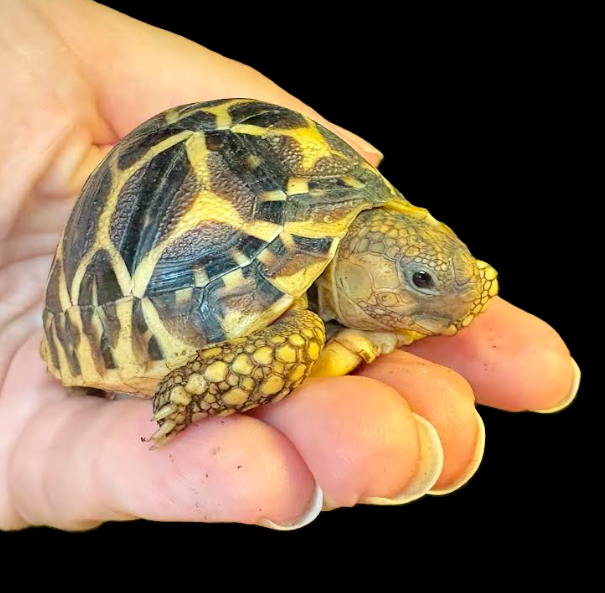
Appearance: The Indian Star Tortoise is famous for its striking geometric shell pattern. Each carapace scute displays radiating yellow or tan lines against a dark brown to black background, creating the iconic “star” appearance. The carapace is high-domed and smooth, particularly in females. The plastron is pale yellow with dark blotching. Males tend to be smaller with longer tails and slight plastral concavity, while females are larger and rounder in shape.
Distribution: Native to India, Pakistan, and Sri Lanka, occurring across dry regions, scrublands, and semi-arid grasslands.
Habitat: In the wild, this species inhabits dry scrub forests, thornbush areas, and open grasslands with scattered vegetation. They rely heavily on seasonal monsoon cycles for food availability. In captivity, they require a warm, arid setup with low humidity but access to microclimates with higher moisture in deep hides or burrows.
Behaviour: Indian Star Tortoises are diurnal and generally shy, spending much of their day grazing, hiding under vegetation, or resting in shaded retreats. They adapt well to stable environments but can be sensitive to stress and excessive humidity.
Captive Care
Enclosure: Provide a minimum indoor enclosure of 6 × 3 feet (180 × 90 cm) for an adult, with larger being preferred for females or pairs. Use a dry soil–sand substrate mix that stays dry on the surface but allows some moisture retention below. Include hiding structures, rocks, logs, and shaded retreats. Outdoor housing is possible during warm, dry weather above 78°F (26°C).
Temperature and Humidity:
Ambient daytime: 82 to 90°F (28 to 32°C)
Basking area: 95 to 100°F (35 to 38°C)
Night temperature: 72 to 78°F (22 to 26°C)
Humidity: 40 to 60% overall, with slightly higher humidity pockets in deep hides to support proper hydration.
Lighting: Provide full-spectrum lighting with 10–12% UVB for strong shell and bone health. Ensure a defined basking area along with shaded regions for cooling.
Diet: Offer a strict herbivorous, high-fibre diet including grasses, edible weeds, succulents, hibiscus leaves, and hardy greens. Flowers may be included regularly. Avoid fruits and high-moisture vegetables, as this species is adapted to dry, fibrous foods.
Behaviour in Captivity: Indian Star Tortoises thrive in warm, dry environments with stable conditions. They enjoy grazing and exploring but may become shy if the enclosure is too open or brightly lit. They are sensitive to prolonged humidity and require a well-maintained microclimate balance.
Special Considerations
• Highly sensitive to excessive humidity; dryness is crucial.
• Provide deep substrate for burrowing microclimates.
• Outdoor housing improves enrichment when temperatures allow.
• Avoid fruits and moisture-heavy foods.
Taxonomy Note
Geochelone elegans is closely related to the Burmese Star and Radiated Tortoise within the star-patterned tortoise group. Regional differences exist in colour intensity and size, particularly in Sri Lankan populations, which often grow larger.
Genetics Note
There are no recognised morphs for the Indian Star Tortoise. Variation in star sharpness, contrast, and overall shell shape occurs naturally across different locality groups rather than through selective breeding.
Estimate shipping