

Photo Disclaimer
Description
Italian Wall Lizard (Podarcis siculus klemmeri)
Scientific Name: Podarcis siculus klemmeri
Common Name: Italian Wall Lizard, Klemmer’s Wall Lizard
Species Overview
Size: Adults typically reach 7–9 inches (18–23 cm) in total length, with slender bodies and long tails that compose more than half their length.
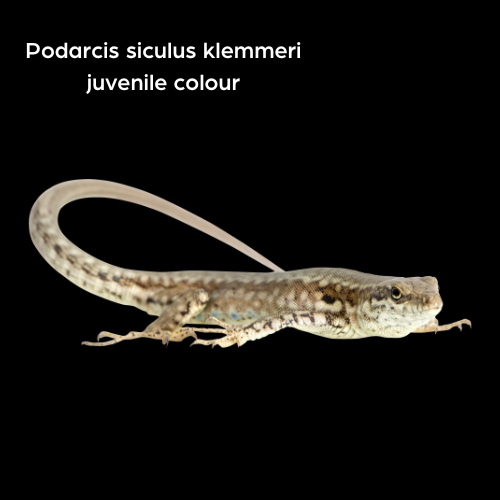
Appearance: The klemmeri subspecies is known for its vivid and contrasting coloration. Individuals often display bright green dorsal surfaces with bold black lateral striping, paired with pale bellies and occasionally blue or turquoise accents along the flanks. The scales are smooth, giving the lizard a sleek appearance suited for rapid movement. Males typically show more intense colours, especially during the breeding season, while females are more subdued but still striking.
Distribution: Native to select regions of Italy, particularly in coastal and island environments where isolated populations developed distinct coloration.
Habitat: This subspecies inhabits rocky outcrops, stone walls, shrubland edges, and sun-exposed areas with ample hiding places. They thrive in Mediterranean climates with hot, dry summers and mild winters. Their agility allows them to navigate cliffs, masonry, and vegetation with ease.
Behaviour: Italian Wall Lizards are diurnal, extremely active, and fast-moving. They are skilled climbers and adept at dashing into crevices when threatened. Their natural diet is omnivorous, consisting of insects, other small invertebrates, and occasional fruit or vegetation. Males are territorial, frequently engaging in visual displays such as head bobs, body posturing, and rapid movements.
Captive Care
Enclosure: Provide a terrestrial–semi-arboreal enclosure at least 30 inches × 12 inches × 12 inches (75 × 30 × 30 cm) for a small group. Include stacked rocks, cork flats, sturdy branches, and dense foliage to mimic natural cover. Ensure numerous crevices and basking platforms. A secure top is essential due to their speed and climbing ability.
Temperature and Humidity:
Basking area: 95–105°F (35–40°C)
Ambient temperature: 80–85°F (27–29°C)
Night temperatures: 65–72°F (18–22°C)
Maintain moderate humidity around 40–60%, with a dry overall environment. Provide a slightly humid hide to assist with shedding.
Lighting: Provide strong full-spectrum lighting with high UVB (10–12%). A 12-hour day cycle supports natural basking and metabolic processes.
Diet: Offer a varied omnivorous diet including small crickets, roaches, black soldier fly larvae, mealworms, and occasional waxworms. Supplement with finely chopped leafy greens, grated vegetables, and small fruit pieces. Use calcium and multivitamin supplements regularly. Feed juveniles daily and adults every 1–2 days.
Behaviour in Captivity: Italian Wall Lizards are lively, curious, and highly visible when comfortable. They spend much of their day basking, foraging, and exploring. Handling is typically not recommended due to their speed and fragility, but they adapt well to observation-based setups.
Special Considerations: Provide abundant visual barriers to reduce stress, especially in groups. Because they are exceptionally quick and prone to sudden bursts of speed, ensure all enclosure openings are secure. Naturalistic enclosures with rockwork and sun-like lighting encourage their most vibrant coloration.
Taxonomy Note
The Italian Wall Lizard is part of the family Lacertidae, a group of agile, sun-loving lizards common throughout Europe. The subspecies Podarcis siculus klemmeri is noted for its distinctive colouring and is valued for its active, bold behaviour in naturalistic enclosures.
Genetics Note
There are no recognized morphs for the Italian Wall Lizard. The “klemmeri” designation reflects a naturally occurring subspecies with population-specific coloration and patterning. Variation is primarily expressed through differences in green intensity, striping clarity, and blue flank highlights, but these are natural locality traits rather than selectively bred morphs.
Estimate shipping