

Photo Disclaimer
Description
Loggerhead Musk Turtle
Scientific Name: Sternotherus minor minor
Common Name: Loggerhead Musk Turtle
Species Overview
Size: Males typically reach 3.5 to 4.5 inches (9 to 11 cm), while females grow larger at 4 to 5.5 inches (10 to 14 cm).
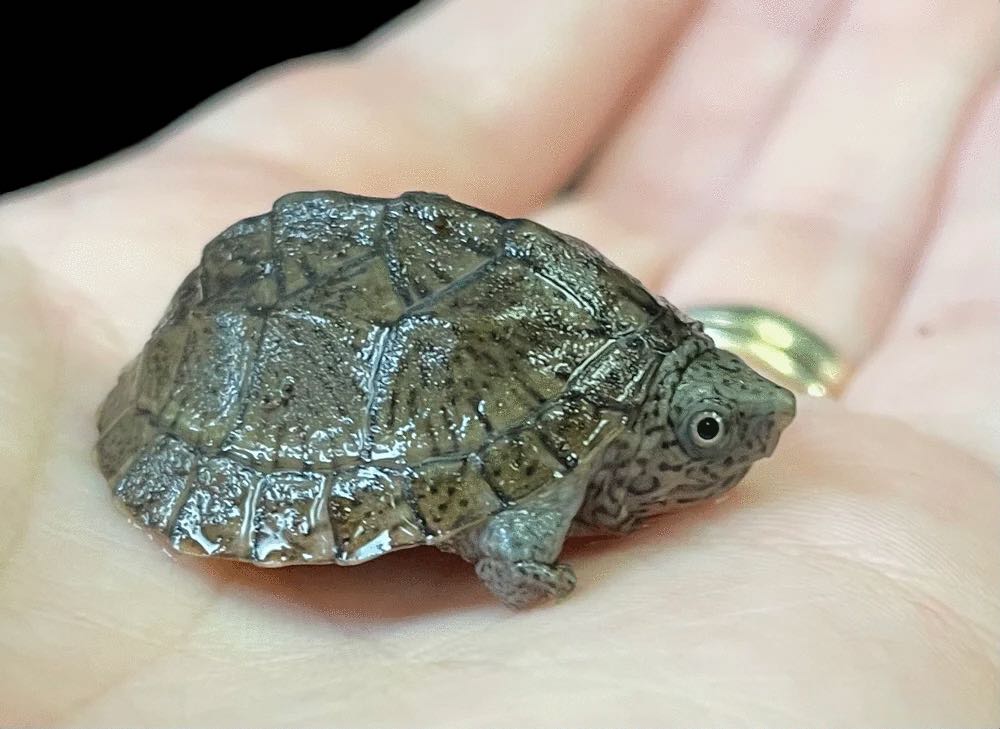
Appearance: The Loggerhead Musk Turtle is recognised for its large, blocky head compared to body size. The carapace is smooth, oval, and typically brown to olive with faint patterning that may fade with age. The head is often marked with pale yellow or cream speckling or striping. The plastron is reduced, typical of musk turtles, allowing high mobility. Males feature longer, thicker tails with a visible spine at the tip, while females are broader and more rounded.
Distribution: Found throughout the southeastern United States, including Florida, Georgia, Alabama, and parts of Tennessee and Mississippi.
Habitat: In the wild, Loggerhead Musk Turtles inhabit slow-moving rivers, springs, creeks, swamps, and vegetated ponds. They favour areas with clean, shallow to moderately deep water, rocky or sandy bottoms, and abundant submerged structure. In captivity, they require a warm aquatic environment with clean water and multiple basking or haul-out options.
Behaviour: This species is primarily aquatic and spends much of its time walking along the bottom rather than swimming long distances. They bask more frequently than many other musk turtles and are generally bold, alert, and active during the day. They may become quite confident and interactive with keepers.
Captive Care
Enclosure: Provide an aquatic enclosure with a minimum footprint of 36 × 18 inches (90 × 45 cm) for one adult, though larger is beneficial. Include moderate water depth, submerged branches, rocks, and hides. A small basking platform or floating dock must be provided. Strong filtration is recommended, as musk turtles produce moderate waste.
Temperature and Humidity:
Water temperature: 75 to 80°F (24 to 27°C)
Basking area: 88 to 92°F (31 to 33°C)
Ambient air temperature: 78 to 84°F (26 to 29°C)
Lighting: Provide full-spectrum lighting with 10–12% UVB to support proper shell health and overall metabolism. Although primarily aquatic, Loggerhead Musk Turtles bask regularly, so a clear, stable basking spot is essential.
Diet: Offer a varied omnivorous diet rich in animal matter, including insects, earthworms, snails, small fish, crustaceans, commercial turtle pellets, and occasional leafy greens or aquatic plants. Juveniles require higher protein intake, while adults benefit from a balanced mix.
Behaviour in Captivity: Loggerhead Musk Turtles are active bottom-walkers and frequent baskers. They adapt well to captivity when provided strong filtration and stable heat. With time, many become bold feeders and eager explorers of their environment.
Special Considerations
• Provide multiple hiding areas both underwater and at the surface.
• Strong filtration and regular water changes are important.
• Avoid deep water with no resting points; offer submerged platforms.
• Juveniles consume more protein than adults.
Taxonomy Note
Stenotherus minor includes several subspecies, but the Loggerhead form (S. m. minor) is the most commonly kept in captivity. Its oversized head and distinctive spotting separate it from other musk turtles.
Genetics Note
There are no recognised morphs for the Loggerhead Musk Turtle. Variations in head spotting, shell darkness, and contrast occur naturally among individuals and do not represent selectively bred traits.