

Photo Disclaimer
Description
Olive Tree Skink
Scientific Name: Dasia olivacea
Common Name: Olive Tree Skink, Olive Dasia
Species Overview
Size: Adults typically reach 8 to 12 inches (20 to 30 cm) in total length, with more than half of this length made up by the long, slender tail.
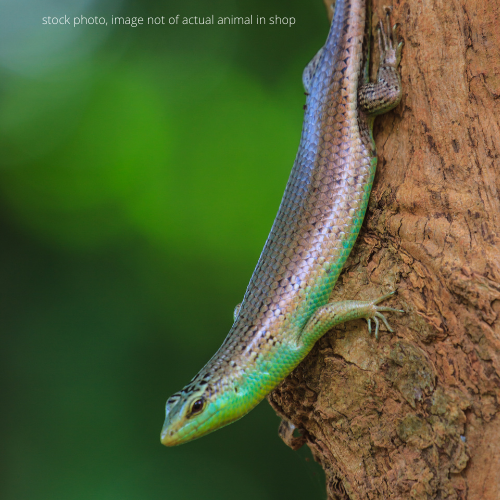
Appearance: Olive Tree Skinks are sleek, semi-arboreal lizards with smooth, glossy scales and a uniformly olive-green to yellow-green colouration. Some individuals display faint lateral mottling or striping. Their head is narrow and tapered, ideal for navigating dense foliage. Limbs are long and agile, equipped with sharp claws for climbing, and the tail is long and whip-like, aiding balance and quick vertical movement.
Distribution: Found throughout Southeast Asia, including Thailand, Malaysia, Singapore, Indonesia, Brunei, and parts of the Philippines.
Habitat: This species inhabits tropical lowland forests, mangroves, palm plantations, and forest edges. They are primarily arboreal, frequenting trunks, vines, and dense vegetation, especially near water.
Behaviour: Olive Tree Skinks are diurnal, alert, and fast-moving. When startled, they typically flee upward into foliage. Their diet consists mainly of insects and small invertebrates, though some individuals may take soft fruits or nectar. They are naturally shy and prefer to keep hidden among leaves and branches.
Captive Care
Enclosure: Provide a vertically oriented enclosure at least 36 × 18 × 36 inches (90 × 45 × 90 cm) for an adult. Include a variety of upright branches, bamboo, cork rounds, vines, and dense foliage to mimic their natural forest environment. Heavy planting or visual cover is strongly recommended.
Temperature and Humidity:
Basking area: 90 to 95°F (32 to 35°C)
Ambient daytime temperature: 78 to 84°F (26 to 29°C)
Night temperatures: 70 to 75°F (21 to 24°C)
Humidity should remain high at 70 to 90 percent, supported by daily misting and strong plant cover.
Lighting: Provide full-spectrum lighting with moderate UVB (5 to 7 percent). Bright but diffused lighting suits their preference for filtered forest light.
Diet: Offer a varied insect diet including crickets, roaches, black soldier fly larvae, silkworms, small hornworms, snails, and flies. Occasional soft fruits or nectar blends may be accepted. Supplement insects with calcium frequently and multivitamins weekly.
Behaviour in Captivity: Olive Tree Skinks are fast, easily startled, and best kept as display animals. They thrive in quiet, naturalistic enclosures with dense foliage, showing active climbing and foraging when they feel secure. Handling is not recommended due to their speed and sensitivity.
Special Considerations:
• Provide abundant vertical climbing structure and foliage.
• Maintain high humidity with good ventilation.
• Escape-proof setups are essential due to their slim bodies and agility.
• Avoid frequent handling—this species is highly stress-prone.
Taxonomy Note
The Olive Tree Skink belongs to the genus Dasia, a group of arboreal Southeast Asian skinks adapted to humid tropical forests. Dasia olivacea is one of the larger and more widespread species within the group.
Genetics Note
No recognized morphs exist for this species. Natural variation includes subtle shifts in olive tone, faint mottling, and variations in green or yellow saturation across different localities and individuals.