


Photo Disclaimer
Description
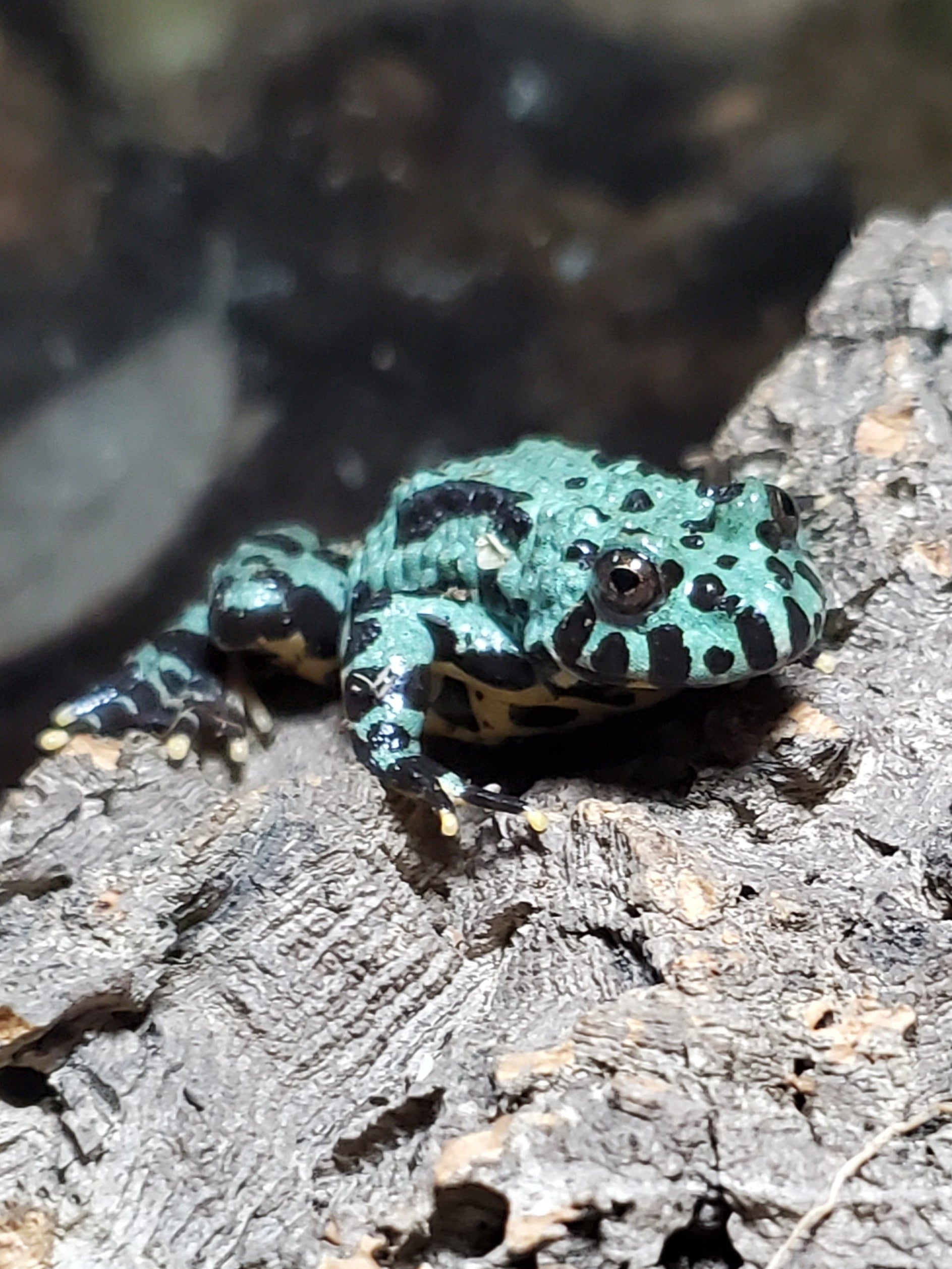
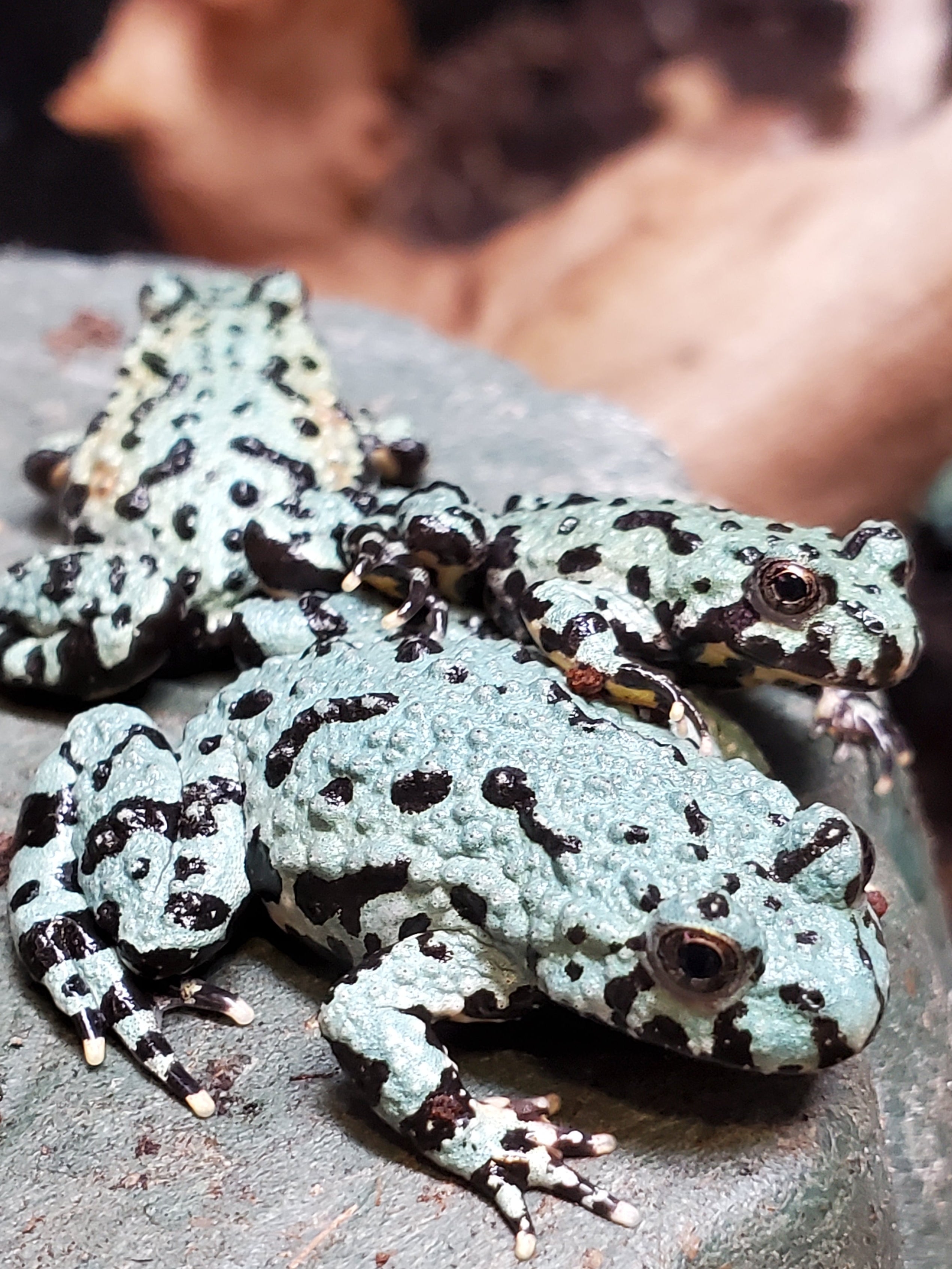
Oriental Fire-bellied Toad (Axanthic)
Scientific Name: Bombina orientalis
Common Name: Oriental Fire-bellied Toad (Axanthic)
Species Overview
Size: Adults typically reach 1.5 to 2.5 inches (4 to 6.5 cm), with females often slightly larger and heavier-bodied than males.
Appearance: The Axanthic Oriental Fire-bellied Toad lacks the yellow pigment normally present in the species, resulting in cool-toned greens, greys, and muted olives on the dorsum instead of the bright lime to yellow-green shades of the wild form. The iconic ventral patterning remains bold, but the normally red or orange belly may display a deeper red or more subdued tone depending on individual expression. The skin retains its characteristic bumpy texture, and the parotoid glands are subtle compared to terrestrial toads. Eyes are golden to copper with horizontal pupils. The overall structure is compact and semi-aquatic, with strong limbs for both swimming and climbing.
Distribution: The species is native to northeastern China, Korea, and parts of the Russian Far East. The axanthic form is the result of selective captive breeding rather than a naturally occurring population.
Habitat: Wild Oriental Fire-bellied Toads inhabit forest edges, wetlands, ponds, slow-moving streams, and marshy areas. They alternate between aquatic and terrestrial environments. In captivity, they require a paludarium setup offering both shallow water and land access.
Behaviour: Diurnal and active, these toads are bold, social, and visually oriented. They exhibit the characteristic “unken reflex”, arching their body to display their bright warning colours when threatened. They are vocal, especially males, and may live peacefully in small groups given adequate space.
Captive Care
Enclosure: A single adult or small group can be housed in a 24 × 18 × 18 inches (60 × 45 × 45 cm) enclosure. A paludarium layout is ideal, providing roughly half land and half shallow water. Land areas should include moist soil or moss substrate, cork flats, bark, smooth stones, and live or artificial plants for cover. Water areas should be shallow, filtered, and easy to exit, with rocks or ramps to prevent drowning. For larger groups, upgrading to 36 × 18 × 18 inches (90 × 45 × 45 cm) improves space and reduces competition.
Temperature and Humidity:
Ambient temperature: 72 to 78°F (22 to 26°C)
Warm area: 80°F (27°C)
Night temperature: 65 to 70°F (18 to 21°C)
Humidity: 60 to 80%, with regular misting and good airflow to prevent stagnation.
Lighting: Provide low to moderate UVB (2 to 5%) with bright but indirect lighting to support natural activity and plant growth. A consistent day and night cycle is important. Avoid overly intense lighting, as axanthic individuals may be more light-sensitive.
Diet: Offer a varied diet of small insects such as crickets, roaches, worms, black soldier fly larvae, and suitable aquatic invertebrates. Feed juveniles more frequently and adults on a controlled schedule. Supplement prey with calcium and vitamins as appropriate.
Behaviour in Captivity: Active and engaging, Oriental Fire-bellied Toads readily display natural behaviours in well-structured habitats. They are social and often more confident when kept in groups. Handling should be minimal due to sensitive skin and the mild toxins they produce.
Genetics Note
Axanthic (recessive): This gene removes yellow pigment from the toad’s colour profile, producing cooler greens, greys, and muted tones while leaving the red ventral pattern intact. The axanthic trait is recessive, meaning both parents must carry the allele for the offspring to express it. No additional morphs are formally recognised for this species.
Estimate shipping