

Photo Disclaimer
Description
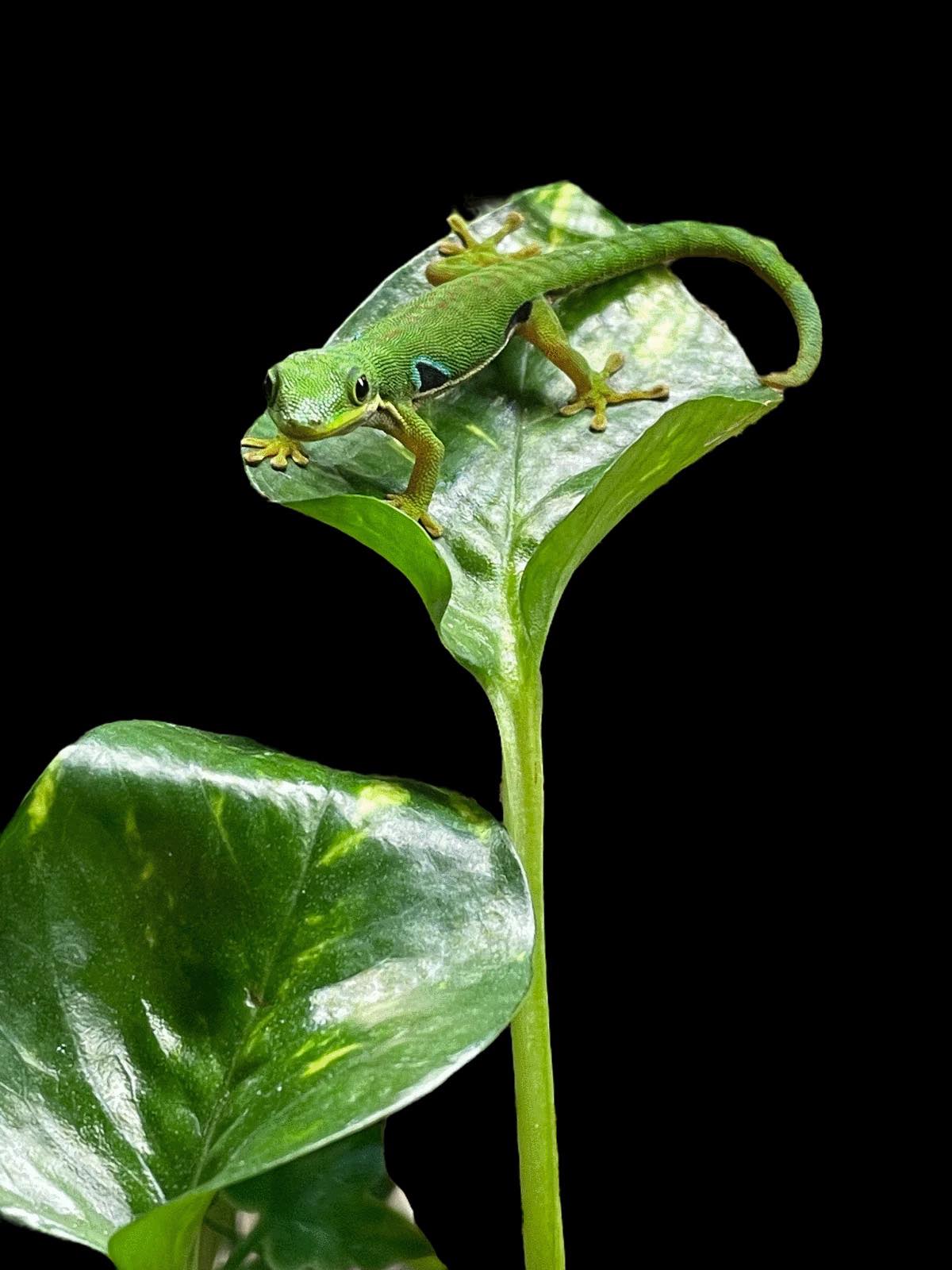
Peacock Day Gecko
Scientific Name: Phelsuma quadriocellata quadriocellata
Common Name: Peacock Day Gecko, Four-Spotted Day Gecko
Species Overview
Size: Adult Peacock Day Geckos typically reach 4.5–6 inches (11–15 cm) in total length, including the tail. They are small to medium-sized Phelsuma with slender bodies and smooth, glossy scales.
Appearance: The Peacock Day Gecko is one of Madagascar’s most visually striking small day geckos. It features a bright green to turquoise base colour, often with a bluish sheen, accented by vivid red or orange spots along the back and head. The most distinctive feature is the presence of two pairs of black-ringed blue eye-spots—one near the shoulders and another near the hind legs—giving rise to its name “Peacock.” The tail and limbs may display faint striping, while the underside is pale yellow or cream. Males often exhibit more intense coloration and larger eye-spots than females.
Distribution: Endemic to eastern Madagascar and several surrounding offshore islands.
Habitat: In the wild, Peacock Day Geckos inhabit humid tropical forests, particularly areas with abundant foliage, bamboo, and smooth tree trunks. They are commonly seen basking on leaves or branches in dappled sunlight. In captivity, they thrive in planted, humid enclosures with high vertical space and gentle airflow.
Behaviour: This species is diurnal, agile, and highly visual. Males are territorial and will chase or display to rivals. Although fast and delicate, they are bold feeders and readily visible during the day. Handling should be avoided, as their skin is fragile, but they make exceptional display reptiles in naturalistic setups.
Captive Care
Enclosure: Provide a vertically oriented terrarium measuring at least 18 inches × 18 inches × 24 inches (45 × 45 × 60 cm) for one adult or a compatible pair. Include bamboo sections, cork branches, and live plants such as Pothos, Ficus, or Schefflera for cover and climbing. Ensure secure ventilation and a tight-fitting lid to prevent escapes.
Temperature & Humidity: Maintain daytime temperatures between 78–86°F (26–30°C) with a basking area near 90°F (32°C). Nighttime temperatures can drop to 70–75°F (21–24°C). Humidity should range from 65–85%, achieved through daily misting and the use of live plants. Allow short drying periods between misting to prevent stagnant air.
Lighting: Peacock Day Geckos require strong full-spectrum lighting with a 5–7% UVB output to support calcium metabolism and vivid coloration. Maintain a 12-hour day/night cycle, ensuring both bright basking areas and shaded retreats for thermoregulation.
Diet: Offer a varied diet of small, gut-loaded insects such as crickets, roaches, and black soldier fly larvae, supplemented with commercial gecko fruit and nectar mixes. Feed juveniles daily and adults every other day. Dust insect prey with calcium and multivitamin supplements regularly.
Behaviour in Captivity: With consistent care, Peacock Day Geckos are hardy, colourful, and active display animals. They are confident feeders and frequently visible during the day. Provide abundant climbing opportunities and plant cover to encourage natural activity and reduce stress.
Special Considerations: Males should never be housed together due to territorial aggression. Their skin is delicate and can easily tear, so handling is discouraged. Ensure stable humidity and proper ventilation to prevent shedding and respiratory issues.
Taxonomy Note
The Peacock Day Gecko (Phelsuma quadriocellata quadriocellata) belongs to the family Gekkonidae and represents the nominate subspecies of the Phelsuma quadriocellata complex, which includes several regional variants such as P. q. bimaculata and P. q. lepida. It is distinguished by its vivid blue-ringed eye-spots and brilliant green body. Like all Phelsuma, it is diurnal, arboreal, and equipped with adhesive toe pads for climbing smooth surfaces.
Genetics Note
There are currently no recognized morphs of Phelsuma quadriocellata quadriocellata. Natural variation occurs between localities, particularly in the size and brightness of the eye-spots and the intensity of body coloration. These variations are naturally occurring rather than selectively bred traits.