
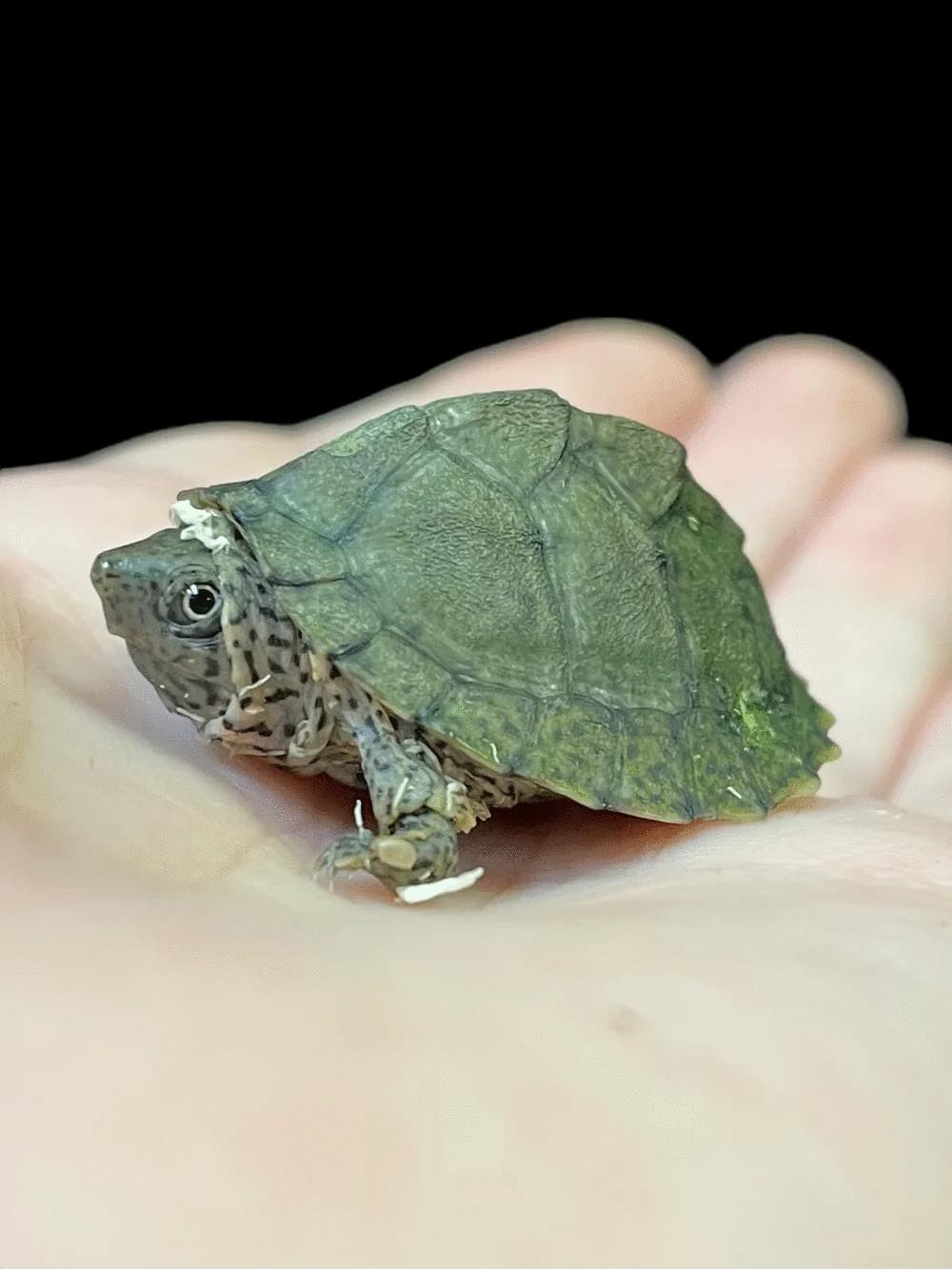
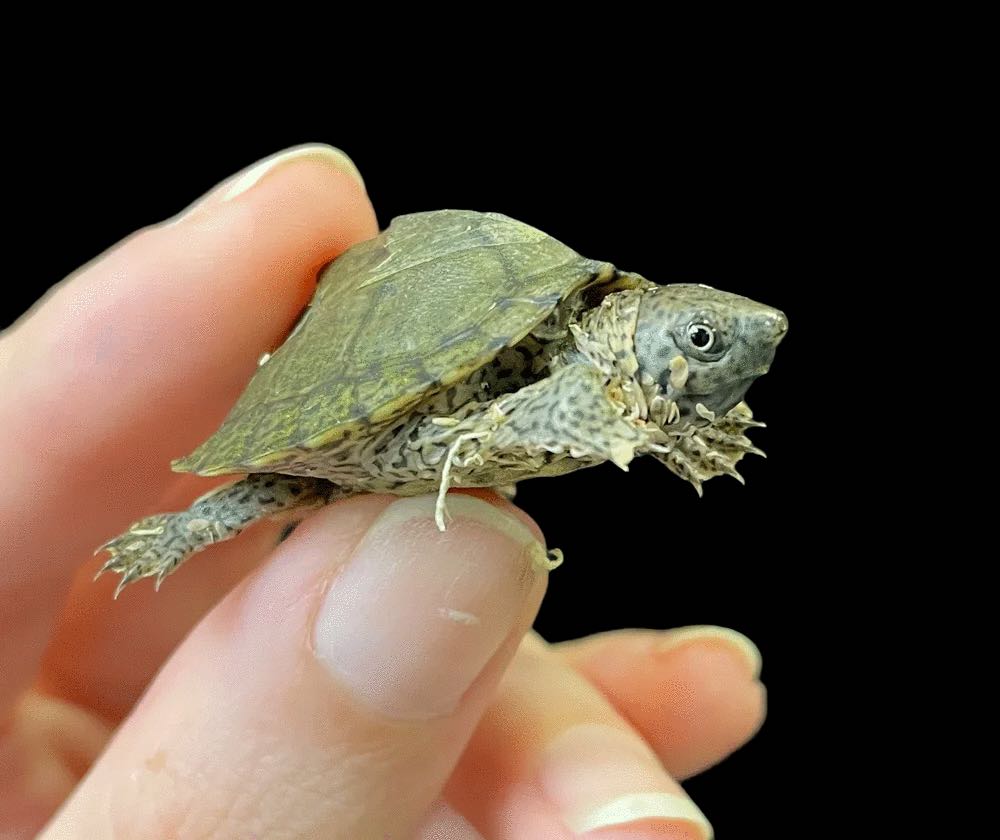


Photo Disclaimer
Description
Razorback Musk Turtle
Scientific Name: Sternotherus carinatus
Common Name: Razorback Musk Turtle
Species Overview
Size: Males typically reach 4.5 to 5 inches (11 to 13 cm), while females grow larger at 5 to 6 inches (13 to 15 cm).
Appearance: The Razorback Musk Turtle is easily identified by the prominent, raised keel running down the centre of its carapace, giving it a sharp “razorback” profile. The shell is typically light to dark brown with subtle patterning that darkens with age. The head is large and triangular with fine mottling or speckling in shades of grey, cream, and brown. The plastron is small and light-coloured, typical of musk turtles. Females tend to be broader and heavier-bodied, while males have longer, thicker tails.
Distribution: Found throughout the south-central United States, including Texas, Louisiana, Oklahoma, Arkansas, and Mississippi.
Habitat: In the wild, this species inhabits slow-moving or still freshwater systems such as bayous, swamps, ponds, and quiet river backwaters. They favour soft substrates, submerged logs, and heavy cover. In captivity, they require warm, clean water with plenty of structure and secure basking access.
Behaviour: Razorback Musk Turtles are diurnal to crepuscular, strong bottom-walkers, and frequent baskers compared to other musk turtles. They are generally shy but become outgoing over time, especially at feeding.
Captive Care
Enclosure: Provide an aquatic enclosure with a minimum footprint of 36 × 18 inches (90 × 45 cm) for one adult, though larger is encouraged. Offer moderate water depth, submerged branches, rock caves, and floating or fixed basking platforms. Provide gentle slopes or resting ledges, as this species prefers climbing and bottom-walking to prolonged free swimming. Strong filtration is required.
Temperature and Humidity:
Water temperature: 75 to 80°F (24 to 27°C)
Basking area: 88 to 92°F (31 to 33°C)
Ambient air temperature: 78 to 84°F (26 to 29°C)
Lighting: Provide full-spectrum lighting with 10–12% UVB to support healthy bone and shell development. Ensure the basking area is stable, dry, and easily accessible.
Diet: Offer a varied omnivorous diet including insects, earthworms, snails, crustaceans, small fish, aquatic invertebrates, high-quality turtle pellets, and occasional leafy greens or aquatic plants. Juveniles require higher protein levels, while adults benefit from a balanced mixture of animal and plant matter.
Behaviour in Captivity: Razorback Musk Turtles are active, inquisitive, and enjoy climbing on submerged structure. They appreciate complex environments and become more confident with consistent, stable care. They readily bask and are strong feeders when well-adjusted.
Special Considerations
• Provide multiple underwater hides and resting points.
• Sensitive to poor water quality—filtration must be robust.
• Avoid extremely deep water without resting ledges.
• Juveniles require a higher protein diet.
Taxonomy Note
Sterntotherus carinatus is one of the most recognisable musk turtles due to its tall central keel and semi-aquatic basking tendencies. It is closely related to the Common Musk Turtle but differs in shell shape and behaviour.
Genetics Note
There are no recognised morphs for the Razorback Musk Turtle. Variations in shell shade, head mottling, and keel prominence occur naturally among individuals and represent normal species diversity.
Estimate shipping