

Photo Disclaimer
Description
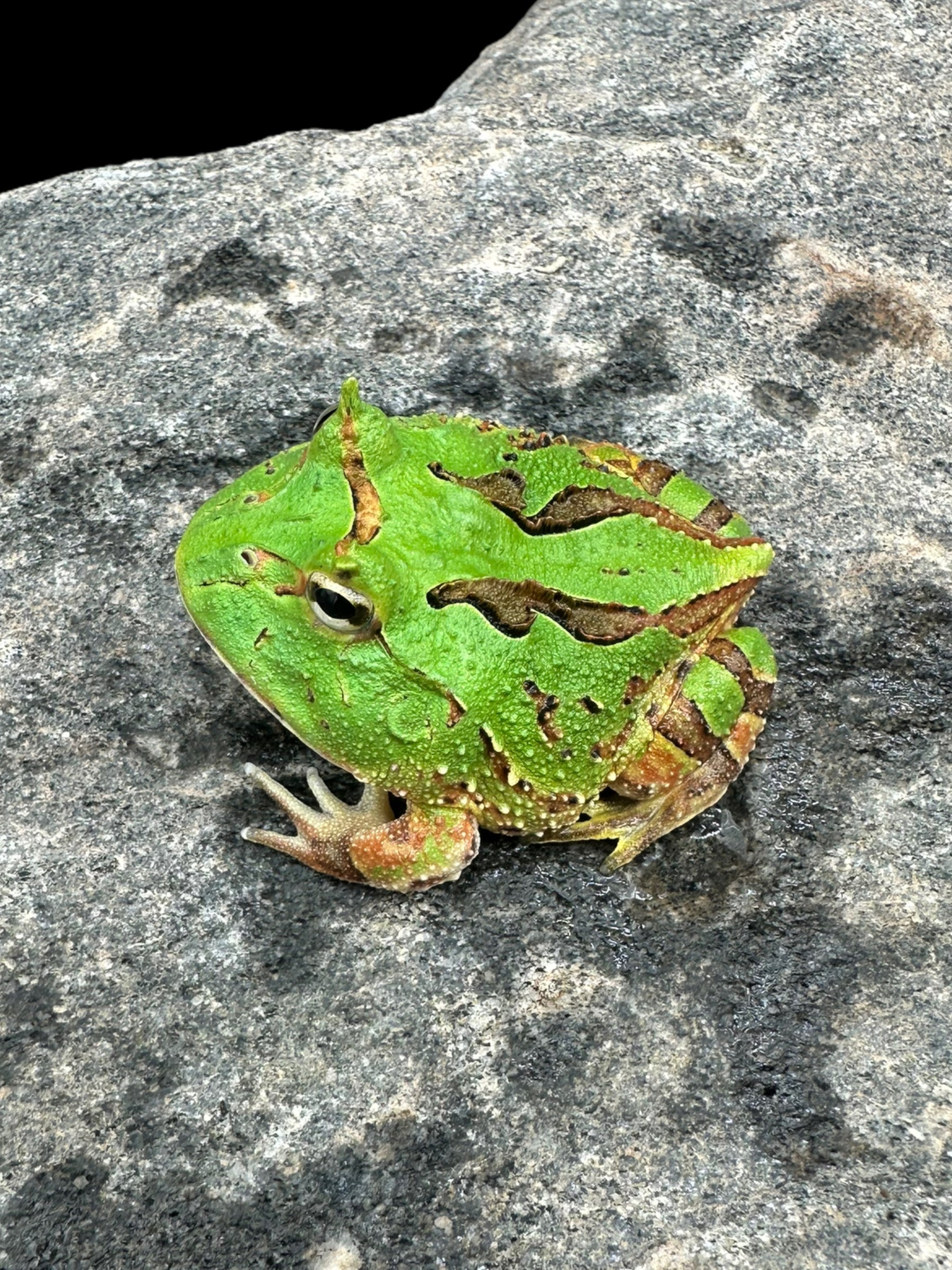
Fantasy Horned Frog (Green)
Scientific Name: Ceratophrys cranwelli × Ceratophrys cornuta
Common Name: Fantasy Horned Frog, Green Pacman Frog
Species Overview
Size: Adults typically reach 6–8 inches (15–20 cm), with females slightly larger than males.
Appearance: This hybrid displays a predominantly green colouration inherited from its parent species, often accented with subtle brown or yellow blotches. The head is broad and flat with characteristic horned ridges above the eyes, and the mouth is large and capable of consuming sizeable prey relative to body size. Skin is smooth, thick, and slightly waxy, typical of Ceratophrys species.
Distribution: Captive-bred hybrid; no natural distribution.
Habitat: Terrestrial ambush predator preferring forest floor microhabitats with leaf litter, low vegetation, and shaded, moist areas. Spends much of its time partially buried, emerging primarily to feed.
Behaviour: Sit-and-wait predator with minimal movement during the day. Highly territorial and aggressive toward conspecifics or other amphibians of similar size.
Captive Care
Enclosure: A single adult should be housed in an 18 × 18 × 18 inches (45 × 45 × 45 cm) enclosure. Larger adults may benefit from a 24 × 18 × 18 inches (60 × 45 × 45 cm) setup to provide extra floor space. Include a deep substrate of coco fibre or soil topped with leaf litter to allow full burrowing. Provide cork flats, hides, and dense ground cover for security. A shallow water dish should be available for soaking and refreshed daily.
Temperature and Humidity:
Warm area: 80–85°F (27–29°C)
Cool area: 72–75°F (22–24°C)
Humidity: 65–80%, maintained with regular misting and a damp substrate without waterlogging.
Lighting: Low-intensity lighting on a 12-hour cycle. Optional low-level UVB may support general health.
Diet: Feed appropriately sized insects such as crickets, roaches, and earthworms. Adults may occasionally take pinky mice. All prey should be gut-loaded and supplemented with calcium; multivitamins offered periodically.
Behaviour in Captivity: Sedentary and primarily buried, the frog feeds with sudden lunges. Handling should be avoided to prevent stress and defensive biting.
Special Considerations:
• House singly—highly aggressive and cannibalistic
• Monitor diet to prevent obesity
• Use tongs for feeding to avoid bites
• Maintain a clean, damp substrate to prevent skin issues
Taxonomy Note
This hybrid is a cross between Ceratophrys cranwelli and Ceratophrys cornuta, combining terrestrial ambush behaviour and physical traits of both parents. Hybrids are captive-bred only and exhibit intermediate characteristics.
Genetics Note
This is a captive-bred hybrid; colour and pattern are influenced by the combination of parental genetics. The green expression is dominant in some offspring but does not follow a simple single-gene inheritance.
Estimate shipping