
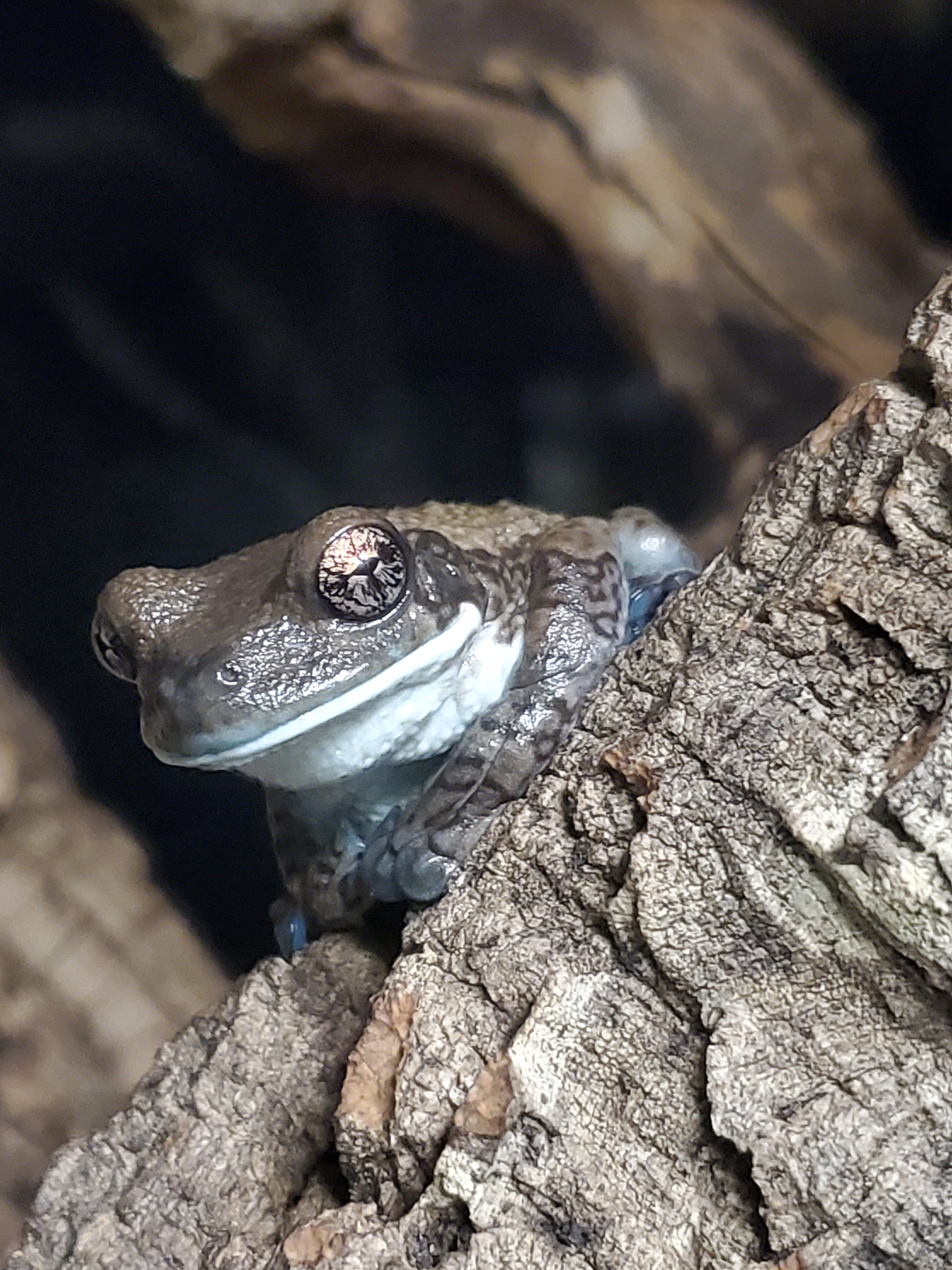
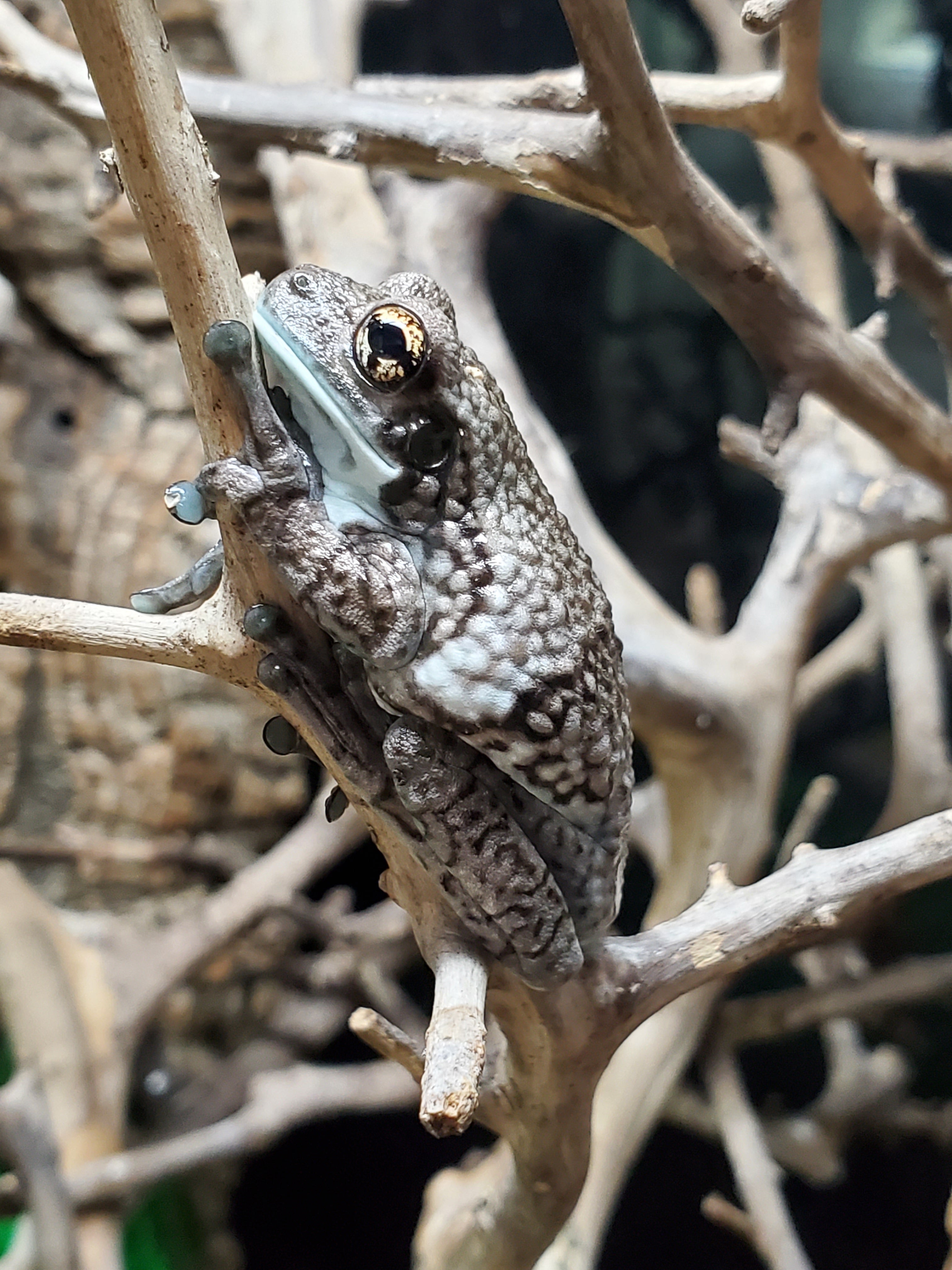


Photo Disclaimer
Description
Veined Milk Frog
Scientific Name: Trachycephalus typhonius
Common Name: Veined Milk Frog, Tiger-striped Tree Frog
Species Overview
Size: Adults typically reach 3 to 5 inches (7.5 to 12.5 cm), with females slightly larger.
Appearance: The Veined Milk Frog is a robust arboreal species with a smooth to slightly granular dorsum patterned in bold marbling or veining. Base colours range from tan, brown, and grey to olive, overlaid with darker irregular bands or vein-like networks that give the species its common name. The underside is pale, and the limbs are thick with strong toe pads. When stressed, the frog may secrete a sticky white substance—hence the “milk frog” name. Eyes are large and golden with horizontal pupils, and some individuals show faint bluish tones on the limbs.
Distribution: Widely distributed across Central and South America, including Panama, Colombia, Ecuador, Peru, Venezuela, the Guianas, Bolivia, and parts of Brazil.
Habitat: Found in humid lowland forests, flooded forests, forest edges, and vegetation near rivers, swamps, and temporary pools. This species is adaptable and may also occur in secondary growth or disturbed habitats as long as water sources are nearby.
Behaviour: Primarily nocturnal, Veined Milk Frogs are strong climbers and bold feeders. They rest during the day in tree hollows, leaf axils, or hidden among dense foliage. Males call loudly during rainy periods, often gathering in groups near suitable breeding sites.
Captive Care
Enclosure: A single adult or small group thrives in an 18 × 18 × 24 inches (45 × 45 × 60 cm) enclosure, though this larger species benefits from a 24 × 18 × 24 inches (60 × 45 × 60 cm) setup. Provide solid climbing branches, cork rounds, broad leaves, and secure elevated perches. Use a moisture-retentive but well-drained substrate such as coco fibre, soil blends, or sphagnum mixes. Include a large shallow water basin for soaking.
Temperature and Humidity:
Ambient temperature: 75 to 82°F (24 to 28°C)
Warm area: 84 to 86°F (29 to 30°C)
Night temperature: 70 to 74°F (21 to 23°C)
Humidity: 60 to 90%, maintained with daily misting and strong ventilation.
Lighting: Provide low to moderate UVB (2 to 5%) with diffused full-spectrum lighting.
Diet: Offer medium to large insects such as crickets, roaches, black soldier fly larvae, silkworms, hornworms, and occasional waxworms. Supplement all prey with calcium and multivitamins.
Behaviour in Captivity: Veined Milk Frogs are hardy, active, and well suited to captivity. They explore vertically, feed eagerly, and tolerate a range of humidity conditions when provided strong airflow. They may secrete a sticky “milk” when stressed. Handling should remain minimal to avoid stress and skin contamination.
Special Considerations:
• If handling is unavoidable, use wet, powder-free gloves or a soft, damp net—their skin secretions can be irritating.
• Provide sturdy décor—these frogs are heavy-bodied and require secure climbing surfaces.
• Maintain strong airflow to reduce the risk of respiratory issues.
• Use only dechlorinated or RO water for misting and hydration.
• Avoid oversaturated substrate; moderate humidity cycles support skin health.
• Ensure all enclosure openings are secure; they are powerful jumpers.
Taxonomy Note
Trachycephalus typhonius belongs to the family Hylidae and is part of a widespread species complex previously grouped under Phrynohyas. It is closely related to the more commonly kept Amazon Milk Frog (Trachycephalus resinifictrix) but differs in patterning, distribution, and ecological range.
Genetics Note
There are no recognised morphs for Trachycephalus typhonius. Natural variation appears in dorsal veining patterns, colour tones, and belly speckling, but none represent defined genetic morphs.
Estimate shipping