

Photo Disclaimer
Description
White-cheeked Mud Turtle
Scientific Name: Kinosternon leucostomum
Common Name: White-cheeked Mud Turtle
Species Overview
Size: Males typically reach 4 to 5 inches (10 to 13 cm), while females grow larger at 5 to 6 inches (13 to 15 cm).
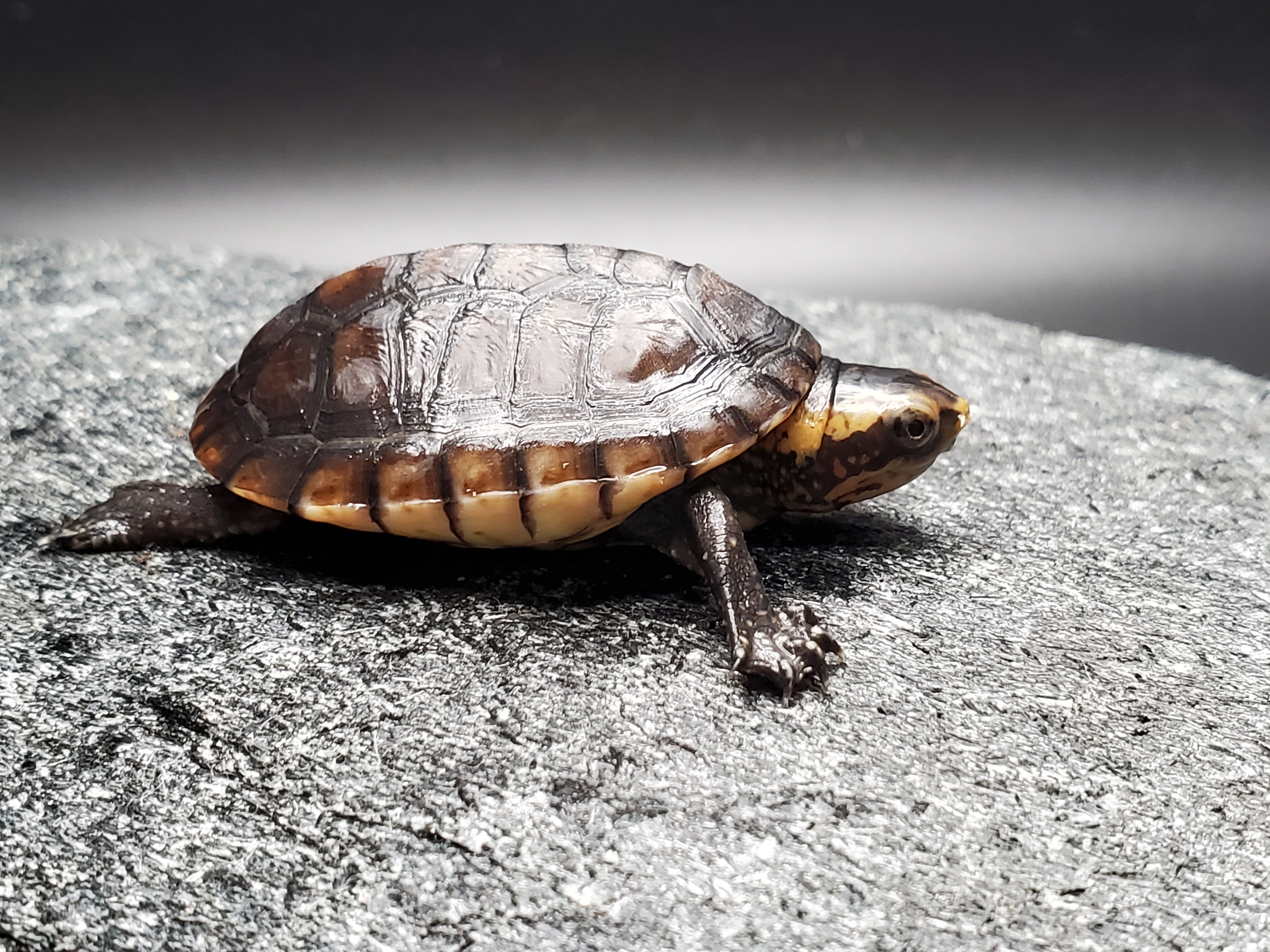
Appearance: The White-cheeked Mud Turtle is distinguished by the pale cream or white patches on each side of the head, contrasting against otherwise dark brown to black skin. The carapace is smooth, oval, and moderately domed, usually dark brown or charcoal, sometimes with faint lighter streaks or age rings. The plastron is tan to yellowish with darker seams and is hinged, allowing partial shell closure. Limbs are sturdy and earth-toned. Males have longer, thicker tails and larger heads, while females are broader and heavier-bodied.
Distribution: Found throughout Central America, including Mexico, Belize, Guatemala, Honduras, Nicaragua, Costa Rica, and parts of Panama.
Habitat: In the wild, this species inhabits marshes, ponds, quiet streams, ditches, lagoons, and seasonal wetlands. They prefer shallow waters with soft muddy bottoms, abundant vegetation, and plenty of submerged cover. In captivity, they require a shallow-to-moderate aquatic enclosure with easy access to basking platforms and sheltered resting zones.
Behaviour: White-cheeked Mud Turtles are diurnal to crepuscular, naturally shy yet adaptable. They spend much of their time walking along the bottom, hiding under debris, or burrowing into soft substrate. They bask occasionally and become bold, eager feeders once accustomed to their environment.
Captive Care
Enclosure: Provide an aquatic enclosure with a minimum footprint of 36 × 18 inches (90 × 45 cm) for one adult. Offer shallow to moderate water depth with resting ledges, submerged logs, leaf litter, rock caves, and floating cover. Include a secure, fully dry basking area. Filtration should be strong but gentle, as the species prefers calmer water.
Temperature and Humidity:
Water temperature: 75 to 80°F (24 to 27°C)
Basking area: 88 to 92°F (31 to 33°C)
Ambient air temperature: 78 to 84°F (26 to 29°C)
Lighting: Provide full-spectrum lighting with 10–12% UVB to support strong shell health and calcium metabolism. Ensure the basking platform is dry, warm, and easy to reach.
Diet: Offer a varied omnivorous diet including insects, worms, snails, aquatic invertebrates, high-quality turtle pellets, small fish, leafy greens, and aquatic plants. Juveniles require more protein, while adults thrive on a balanced mixture that includes more plant matter.
Behaviour in Captivity: This species adapts well to structured habitats with plentiful cover. They enjoy exploring shallow areas, burrowing, and using both underwater and surface hides. They are hardy when kept in clean, warm water and quickly learn feeding routines.
Special Considerations
• Avoid deep water without resting platforms—this species prefers bottom-walking.
• Provide multiple hides in water and on land.
• Use strong but low-flow filtration.
• Juveniles require higher protein levels.
Taxonomy Note
The White-cheeked Mud Turtle belongs to the Kinosternon genus and is closely related to other Central American mud turtles. It is separated from similar species by its pale cheek patches and more streamlined body shape.
Genetics Note
There are no recognised morphs for the White-cheeked Mud Turtle. Differences in cheek colour intensity, shell tone, and head markings are natural expressions of individual or locality variation.