
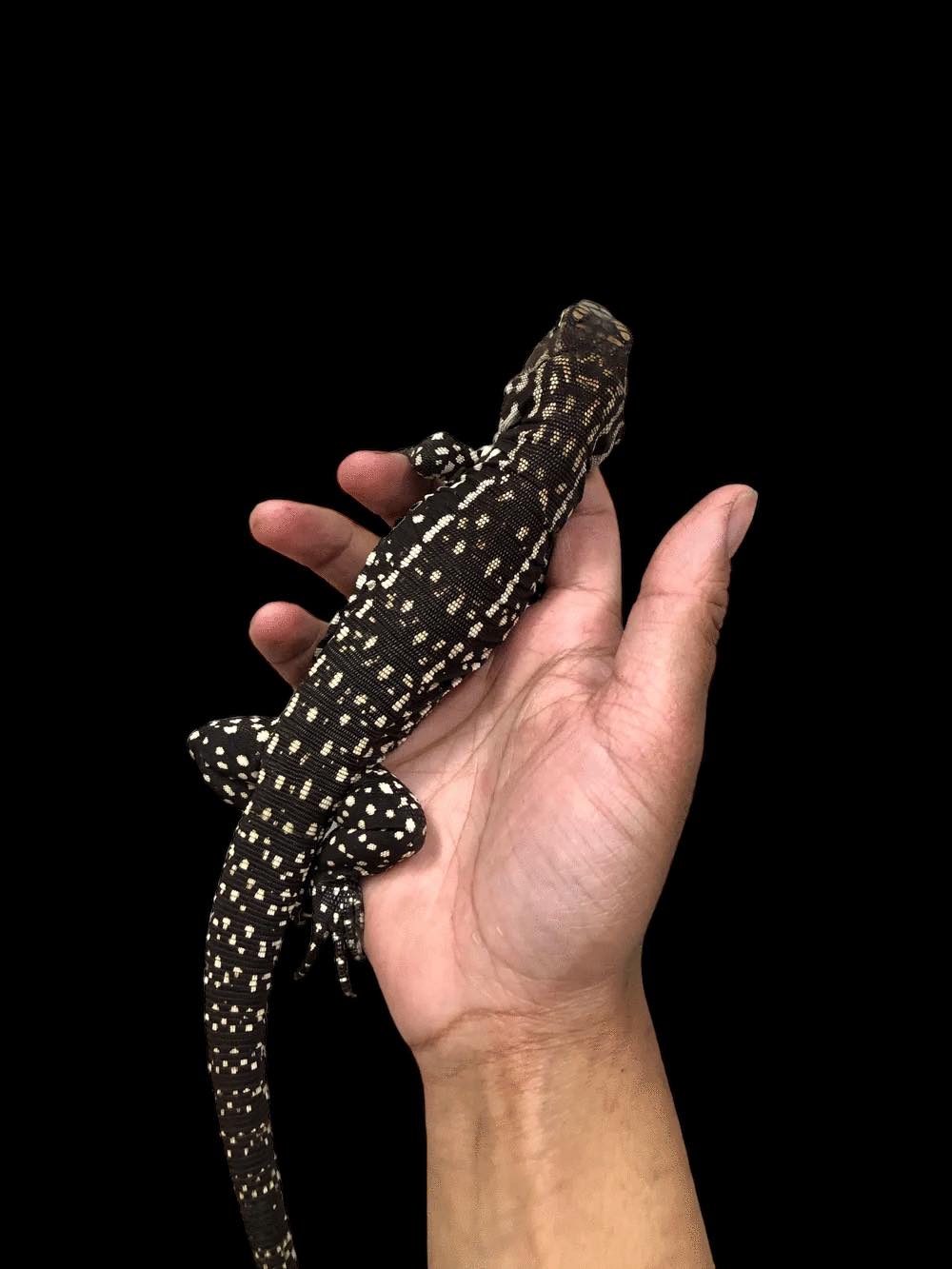
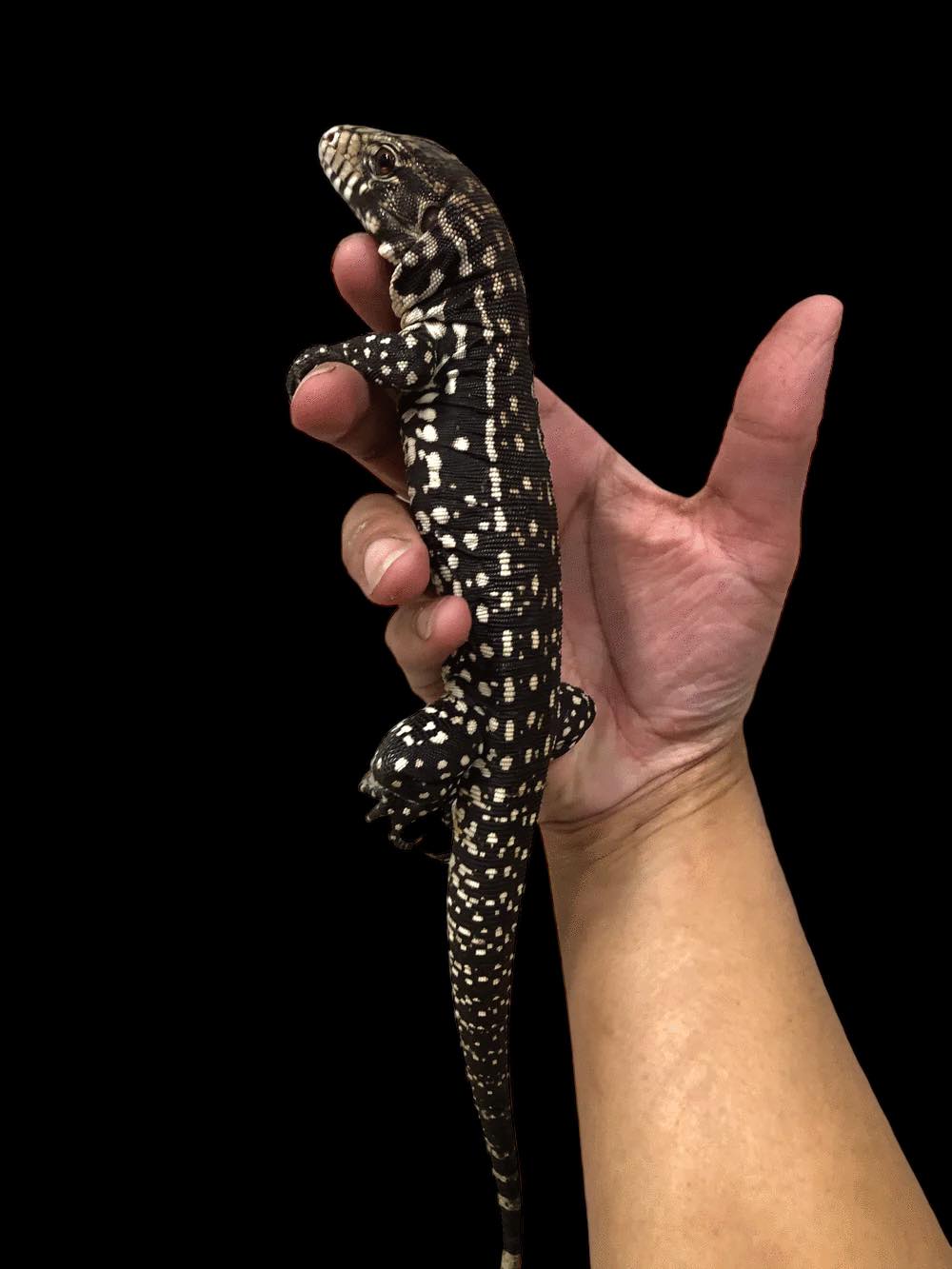


Avis de non-responsabilité concernant les photos
Description
Tegu noir et blanc d'Argentine (Salvator merianae)
Nom scientifique : Salvator merianae
Nom commun : Tegu noir et blanc d'Argentine
Aperçu de l'espèce
Taille : Les adultes atteignent généralement 1 à 1,35 mètre (105 à 135 cm) de longueur totale, les mâles devenant nettement plus massifs et ayant une tête plus large que les femelles.
Apparence : Le tegu noir et blanc d'Argentine est un grand lézard musclé connu pour ses bandes noires et blanches frappantes, ses écailles perlées et ses membres puissants. Les jeunes présentent souvent une coloration verte vive sur la tête qui s'estompe avec l'âge. Les adultes développent un motif très contrasté de bandes noires, de mouchetures blanches et de rayures réticulées sur le dos et la queue. Leurs mâchoires puissantes, leur cou épais et leur corps lourd leur confèrent une présence robuste. Pendant la saison de reproduction, les mâles peuvent développer des bajoues prononcées.
Distribution : Originaire de l'est et du centre de l'Amérique du Sud, notamment de l'Argentine, du Paraguay, du Brésil et de l'Uruguay.
Habitat : Dans la nature, cette espèce habite les prairies, les savanes, les bords de marais, les clairières forestières et les zones offrant de nombreuses possibilités de creuser des terriers. Ils sont semi-aquatiques et très adaptables, capables de prospérer dans des environnements variés. En captivité, ils nécessitent de grandes installations terrestres avec un substrat profond pour creuser.
Comportement : Les tegus noirs et blancs d'Argentine sont diurnes, très intelligents et motivés par la nourriture. Avec des soins et une constance appropriés, ils peuvent devenir très réceptifs et tolérer la manipulation. Ils brument naturellement pendant les mois plus froids, mais peuvent ou non le faire en captivité en fonction de la température et de la photopériode.
Soins en captivité
Enclos : Un grand enclos terrestre est essentiel. Un minimum de 1,8 m × 0,9 m × 0,75 m (72 × 36 × 30 pouces) est recommandé pour un adulte, bien que plus grand soit préférable. Fournir 25 à 30 cm de substrat profond pour creuser, des cachettes solides, des bûches et des plates-formes. Les enclos doivent être sécurisés, car les tegus sont de puissants creuseurs et des artistes de l'évasion.
Température et humidité :
-
Zone de bain de soleil : 46 à 54°C (115 à 130°F)
-
Côté chaud ambiant : 29 à 35°C (85 à 95°F)
-
Côté frais : 24 à 28°C (75 à 82°F)
L'humidité doit rester modérée, entre 60 et 80 %, selon l'âge et le cycle de mue. Vaporiser au besoin, mais éviter un substrat trop humide.
Éclairage : Fournir un éclairage puissant à spectre complet avec UVB à haute intensité (10-14 %) pendant 12 heures par jour. Cette espèce prospère sous une lumière vive et intense qui imite la lumière naturelle du soleil.
Régime alimentaire : Les tegus argentins sont omnivores. Proposer une rotation d'insectes, de viandes maigres, de poissons, d'œufs de caille, de rongeurs (avec parcimonie), de fruits et de légumes. Les juvéniles doivent être nourris quotidiennement ; les adultes mangent 3 à 4 fois par semaine. Compléter tous les aliments avec du calcium et des multivitamines au besoin.
Comportement en captivité : Avec des soins constants, de nombreux tegus argentins deviennent calmes, intelligents et interactifs. Ce sont de puissants fouisseurs et grimpeurs, et ils apprécient l'enrichissement tel qu'un terrain varié, des zones de fouille, des pistes olfactives et des cachettes. Ils nécessitent un espace important et un nettoyage régulier en raison de leur taille et de leur métabolisme.
Considérations spéciales : Les tegus deviennent grands et nécessitent un chauffage, un éclairage et un espace substantiels. Ils sont forts et peuvent causer des blessures s'ils sont effrayés, la manipulation doit donc être confiante et contrôlée. Une humidité et une hydratation appropriées sont essentielles pour prévenir les problèmes de mue. Des enclos sécurisés sont obligatoires.
Note de taxonomie
Le tegu noir et blanc d'Argentine appartient au genre Salvator, qui contient les grandes espèces de tegus sud-américains. S. merianae est l'un des tegus les plus reconnaissables et les plus fréquemment élevés, connu pour son intelligence et son adaptabilité.
Note génétique
Il n'y a pas de morphs naturels officiellement reconnus pour les tegus noirs et blancs d'Argentine de type sauvage. Les populations captives présentent des variations mineures de contraste, de densité des bandes et de rétention de la tête verte chez les juvéniles, mais il s'agit de différences typiques basées sur la localité plutôt que de morphs génétiquement définis. Les morphs albinos, High White, Hypo et autres existent en captivité, mais représentent des lignées d'élevage sélectif distinctes du tegu noir et blanc d'Argentine standard.