

Avis de non-responsabilité concernant les photos
Description
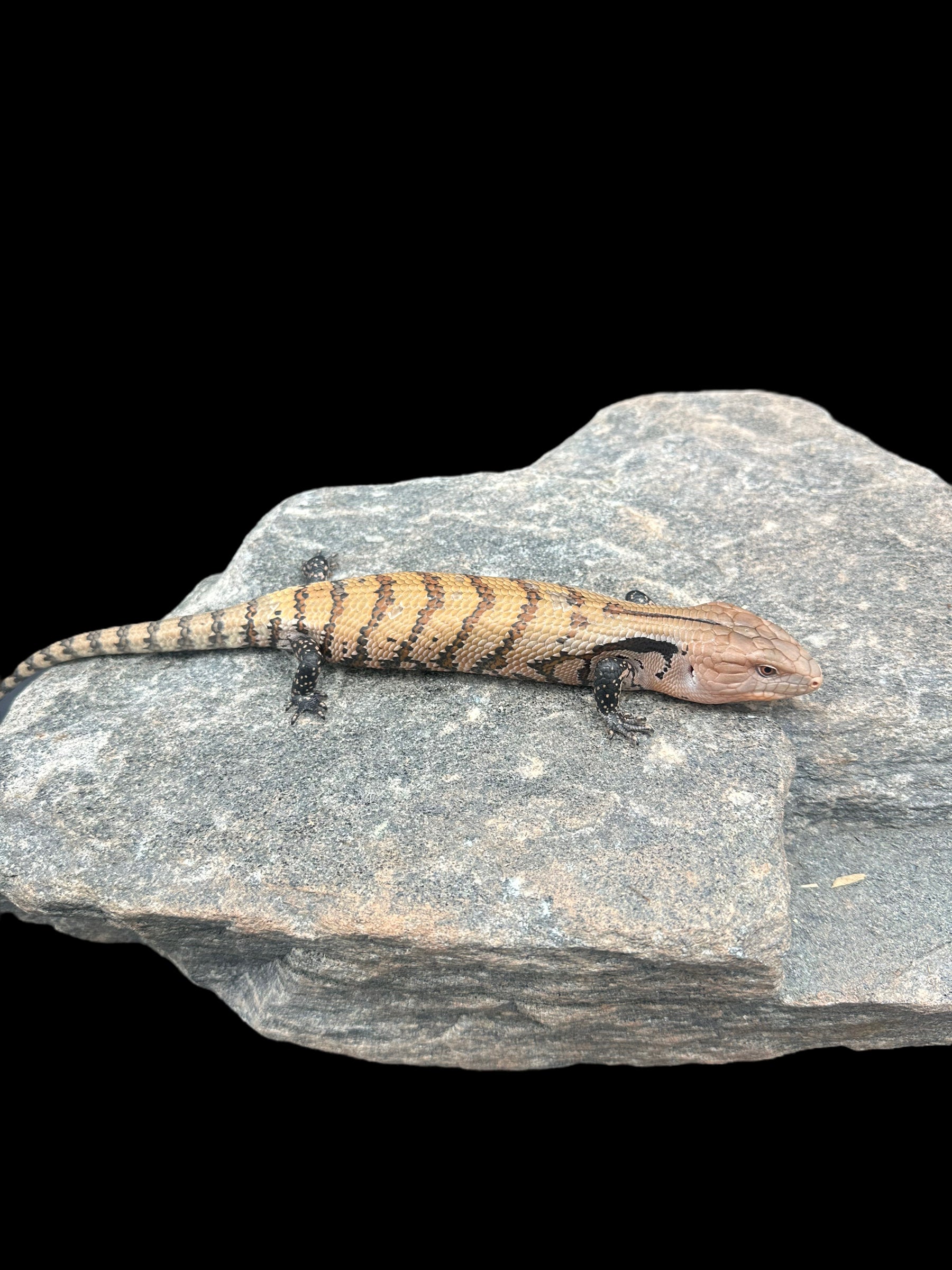
Scinque à langue bleue indonésien (Merauke)
Nom scientifique : Tiliqua gigas
Nom commun : Scinque à langue bleue de Merauke
Aperçu de l'espèce
Taille : Les adultes atteignent généralement 51 à 66 cm (20 à 26 pouces), faisant des Meraukes l'une des localités indonésiennes à langue bleue les plus longues. Ils ont un corps long et élancé, des écailles lisses et une tête large caractéristique.
Apparence : Les scinques à langue bleue de Merauke sont connus pour leur corps allongé et leurs bandes frappantes. Ils présentent généralement des couleurs de base allant du brun clair au beige avec des bandes transversales brun foncé ou noires. De nombreux individus montrent des tons rose pâle ou pêche sur les côtés et la gorge. Leur queue est proportionnellement plus longue que celle de la plupart des autres localités indonésiennes, contribuant souvent à leur longueur totale. Comme tous les scinques à langue bleue, ils arborent l'emblématique langue bleu cobalt utilisée pour la défense.
Distribution : Cette localité est originaire de la région de Merauke, dans le sud de la Papouasie, en Indonésie.
Habitat : Les scinques à langue bleue de Merauke habitent les forêts tropicales humides, les zones humides et les plaines côtières. Ils dépendent d'une végétation dense, d'une litière de feuilles épaisse et de substrats constamment humides pour leur sécurité et leur thermorégulation.
Comportement : Ces scinques sont généralement crépusculaires à diurnes et cherchent refuge dans des espaces de cachette étroits et sécurisés. Ils affichent les défenses classiques des scinques à langue bleue, tels que siffler, se gonfler et montrer leur langue. Les Meraukes sont généralement alertes, curieux et légèrement moins secrets que certaines autres localités indonésiennes, bien que toujours dépendants de l'humidité.
Soins en captivité
Enclos : Fournir un enclos terrestre spacieux d'au moins 120 × 60 × 60 cm (48 pouces × 24 pouces × 24 pouces). Le corps et la queue longs des Meraukes bénéficient d'un grand espace au sol. Inclure un substrat profond pour le creusement, des plaques de liège, des bûches, des cachettes et un feuillage dense.
Température et humidité :
Zone de bain de soleil : 35 à 38°C (95 à 100°F)
Température ambiante : 27 à 29°C (80 à 85°F)
Températures nocturnes : 22 à 24°C (72 à 75°F)
Maintenir l'humidité entre 70 et 90 pour cent en utilisant un substrat profond, des pulvérisations régulières et des enclos partiellement couverts.
Éclairage : Fournir un éclairage à spectre complet avec un UVB modéré (5 à 7 pour cent). Bien que certains éleveurs maintiennent des scinques indonésiens sans UVB, son utilisation est fortement recommandée pour la santé métabolique et l'expression comportementale naturelle.
Alimentation : Offrir une alimentation omnivore variée composée de pâtée pour chien ou chat de haute qualité, de viandes maigres cuites, d'escargots, de blattes, d'œufs durs, de légumes verts à feuilles, de courges, de patates douces, de fruits et de baies. Compléter systématiquement le calcium et utiliser des multivitamines si nécessaire.
Comportement en captivité : Les scinques à langue bleue de Merauke sont généralement calmes, alertes et réactifs. Ils prospèrent avec des routines prévisibles, un substrat profond et des zones de cachette sécurisées. Ils peuvent bien tolérer la manipulation avec une interaction douce et régulière.
Considérations spéciales :
• Les Meraukes nécessitent une humidité constamment élevée pour une mue correcte.
• Leurs queues plus longues rendent la décoration sécurisée de l'enclos particulièrement importante.
• Un substrat profond favorise le creusement et la rétention d'humidité.
• Des niveaux stables d'humidité et d'hydratation sont essentiels pour la santé à long terme.
Note de taxonomie
Le scinque à langue bleue de Merauke est une forme locale de Tiliqua gigas, un complexe d'espèces indigènes d'Indonésie et des régions environnantes. Comparé aux espèces australiennes, les scinques T. gigas sont plus allongés, plus dépendants de l'humidité et présentent des textures d'écailles plus lisses.
Note de génétique
Les scinques à langue bleue de Merauke sont une localité naturelle, pas une morphologie. La variation génétique au sein de la localité inclut des différences de largeur de bande, d'intensité de ton, de teintes latérales roses ou pêches et de longueur de queue. Ces caractéristiques relèvent de la variation géographique normale pour cette population.