

Avis de non-responsabilité concernant les photos
Description
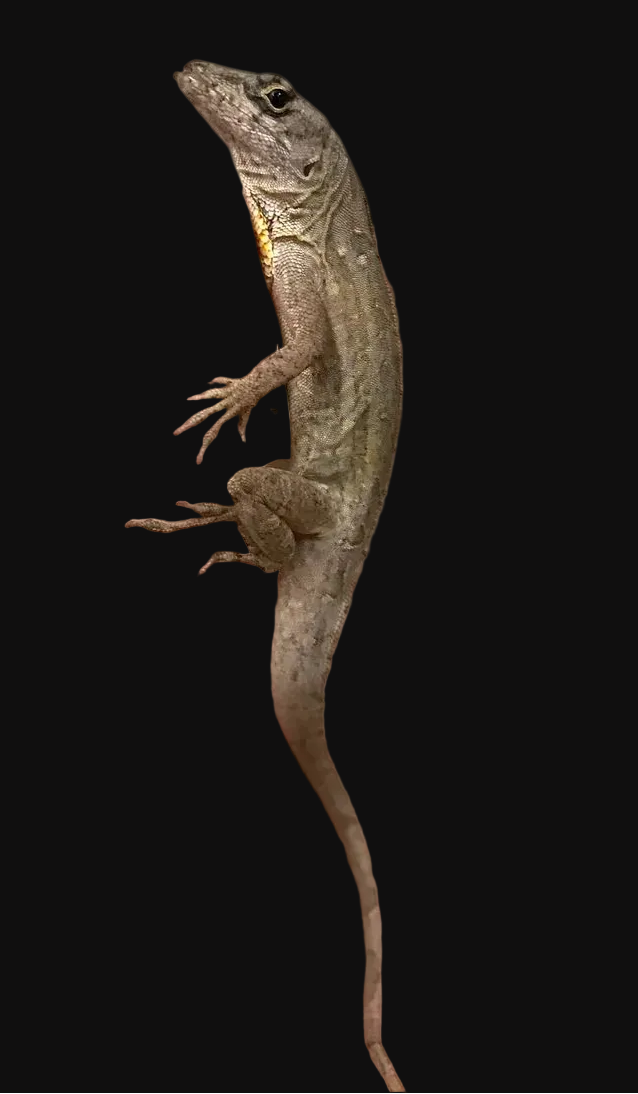
Anolis brun des Bahamas
Nom scientifique : Anolis sagrei
Nom commun : Anolis brun des Bahamas
Aperçu de l'espèce
Taille : Les adultes atteignent généralement 13 à 20 cm (5 à 8 pouces) de longueur totale, les mâles étant plus grands, plus robustes et ayant une queue plus longue que les femelles.
Apparence : L'Anolis brun des Bahamas est un petit lézard adaptable, caractérisé par sa couleur de base terreuse (brun, fauve ou gris) et sa coloration variable. De nombreux individus présentent des rayures dorsales, des taches en forme de losange ou des mouchetures éparses. Les mâles possèdent un fanon vibrant, rouge à orange, souvent bordé de jaune ou de blanc, utilisé pour les parades et la communication. Leurs longs membres, leur tête anguleuse et leur longue queue leur confèrent un profil agile et athlétique. Les tons du corps changent avec la température, l'humeur et l'éclairage, ce qui leur permet de se fondre efficacement dans leur environnement naturel.
Distribution : Originaire des Bahamas, de Cuba et des îles Caraïbes environnantes. Il a également établi des populations introduites en Amérique du Nord et dans plusieurs régions tropicales du monde.
Habitat : Cette espèce privilégie les habitats ensoleillés et ouverts tels que les broussailles, les jardins, les lisières de forêt, les zones rocheuses et les paysages modifiés par l'homme. En captivité, il prospère dans des enclos hauts et bien ventilés, avec de nombreuses structures d'escalade et de la végétation.
Comportement : Les anolis bruns des Bahamas sont diurnes, actifs et territoriaux. Les mâles effectuent des hochements de tête, des parades de fanon et des relevés de queue pour défendre leur territoire. Ils sont vifs et rapides, et sont mieux gardés comme animaux d'exposition. La manipulation est généralement déconseillée en raison de leur petite taille et de leur rapidité.
Soins en captivité
Enclos : Un enclos vertical mesurant 60 × 45 × 60 cm (24 × 18 × 24 pouces) convient pour un petit groupe ou un couple. Fournir des branches, des lianes, de l'écorce de liège, des plantes vivantes ou artificielles et des perchoirs de bronzage surélevés.
Température et humidité : Maintenir une zone de repos de 32 à 35 °C (90 à 95 °F) avec des températures ambiantes diurnes de 25 à 29 °C (78 à 85 °F). La nuit, les températures peuvent descendre à 21 à 24 °C (70 à 75 °F). L'humidité doit rester entre 60 et 75 %, soutenue par une légère nébulisation quotidienne.
Éclairage : Fournir un éclairage à spectre complet avec un UVB modéré (5 %) pendant 12 heures par jour. L'exposition aux UV est essentielle pour un bon métabolisme du calcium et la santé générale.
Régime alimentaire : Offrir de petits insectes tels que des grillons, des drosophiles, des chrysomèles du haricot, des mini-blattes, des isopodes, des vers à soie et des larves de mouches soldat noires. Les juvéniles doivent être nourris quotidiennement ; les adultes peuvent être nourris tous les 1 à 2 jours. Tous les insectes doivent être enrichis et saupoudrés de calcium et de multivitamines. Les anolis s'hydratent principalement grâce aux gouttelettes sur les feuilles, il est donc important de les vaporiser régulièrement.
Comportement en captivité : Les anolis bruns sont des grimpeurs énergiques et des chasseurs actifs. Lorsqu'ils disposent d'un feuillage dense et de structures, ils présentent une gamme complète de comportements naturels, y compris le basking, la parade et la poursuite rapide de proies.
Considérations spéciales : Ces lézards sont sujets aux évasions et sensibles à la déshydratation. Les enclos doivent avoir une maille sécurisée, une ventilation adéquate et une humidité constante. Ils ne doivent pas être manipulés fréquemment en raison de leur fragilité.
Note sur la taxonomie
L'anolis brun des Bahamas appartient au genre Anolis, l'un des genres de reptiles les plus diversifiés au monde. Anolis sagrei est considéré comme un anolis tronc-sol, adapté aux mouvements rapides le long de la végétation basse et dans les espaces ouverts.
Note génétique
Il n'existe pas de morphes reconnus pour l'anolis brun des Bahamas en captivité. Des variations naturelles se produisent dans l'intensité de la couleur du fanon, la coloration dorsale et la teinte générale, mais ces différences reflètent une diversité basée sur la localité plutôt que des morphes génétiquement établis.