
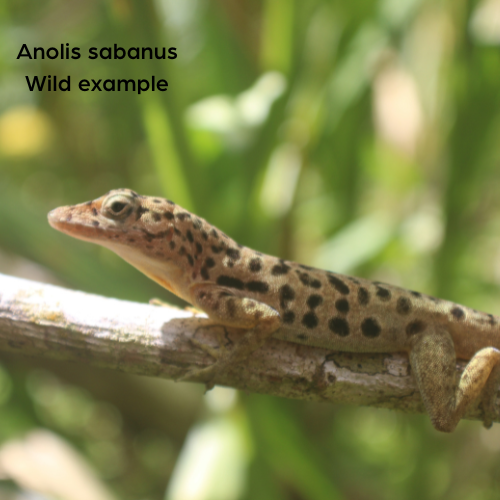

Avis de non-responsabilité concernant les photos
Description
Anolis panthère
Nom scientifique : Anolis sabanus
Nom commun : Anolis panthère, Anolis de Saba
Aperçu de l'espèce
Taille : Les adultes atteignent généralement une longueur totale de 12 à 18 cm (5 à 7 pouces), les mâles étant légèrement plus grands et plus robustes que les femelles.
Apparence : Les anolis panthères sont des lézards agiles et élancés, connus pour leur coloration marron terreux à olive, souvent accentuée par des marbrures plus foncées ou de légères rayures. Certains individus présentent de subtiles nuances de vert selon l'éclairage et l'environnement. Les mâles possèdent un fanon proéminent, généralement orange vif ou jaune avec un liseré contrasté, utilisé pour les parades territoriales et nuptiales. Leurs longs membres, leur corps svelte et leur queue allongée en font d'habiles grimpeurs.
Distribution : Endémique de l'île de Saba dans les Caraïbes néerlandaises, formant une espèce géographiquement isolée et unique.
Habitat : Cette espèce habite les broussailles côtières, les lisières de forêt, les pentes rocheuses et les zones de végétation dispersée. Ils préfèrent les perchoirs exposés au soleil et peuvent être trouvés à diverses altitudes sur l'île. Comme les anolis typiques, ils se déplacent fréquemment entre le sol, les arbustes et les arbres bas.
Comportement : Les anolis panthères sont diurnes, territoriaux et communiquent visuellement. Les mâles effectuent des hochements de tête, des pompes et des extensions de fanon pour repousser les rivaux ou attirer les partenaires. Ils se nourrissent principalement d'insectes et d'autres petits invertébrés. En tant que prédateurs alertes et rapides, ils dépendent fortement des signaux visuels et des réflexes rapides.
Soins en captivité
Enclos : Fournissez un enclos arboricole d'au moins 45 × 45 × 60 cm (18 × 18 × 24 pouces) pour un seul adulte. Incluez de nombreuses structures d'escalade verticales, des plantes vivantes ou artificielles, de l'écorce de liège et des branches. Une bonne ventilation est essentielle.
Température et humidité :
Zone de bain de soleil : 32–35 °C (90–95 °F)
Température ambiante : 24–29 °C (75–85 °F)
Températures nocturnes : 21–24 °C (70–75 °F)
Maintenez l'humidité entre 60 et 80 %, avec une brumisation quotidienne et un bref cycle de séchage entre les pulvérisations.
Éclairage : Fournissez un éclairage puissant à spectre complet avec un UVB modéré (5 à 10 %). Un cycle diurne de 12 heures favorise une activité alimentaire saine, le bain de soleil et la synthèse de vitamine D.
Régime alimentaire : Offrez un régime alimentaire varié d'insectes composé de grillons, de petites blattes, de larves de mouches soldat noires, de drosophiles et occasionnellement de vers de cire ou de vers à corne. Utilisez régulièrement des suppléments de calcium et de multivitamines. Les juvéniles doivent être nourris quotidiennement, tandis que les adultes peuvent être nourris tous les 1 à 2 jours.
Comportement en captivité : Les anolis panthères sont actifs, alertes et s'épanouissent dans des enclos naturalistes et végétalisés. Ils tolèrent rarement la manipulation mais s'adaptent bien aux installations basées sur l'observation. Ils boivent les gouttelettes sur les feuilles après la brumisation, il est donc important de leur offrir des occasions régulières de s'hydrater.
Considérations spéciales : Cette espèce est rapide et facilement effrayée, nécessitant des enclos sécurisés et des pratiques d'entretien douces. Les plantes vivantes aident à stabiliser l'humidité et à réduire le stress. Évitez une manipulation excessive pour éviter les comportements défensifs ou la suppression de l'appétit.
Note taxonomique
L'anolis panthère appartient à la famille des Dactyloidae, un groupe diversifié de lézards arboricoles endémiques des Amériques et des Caraïbes. Anolis sabanus est une espèce insulaire unique connue pour sa spécialisation écologique et sa coloration subtile mais attrayante.
Note génétique
Il n'y a pas de morphotypes reconnus pour l'anolis panthère. Des variations naturelles se produisent dans la luminosité de la couleur du fanon, la tonalité du corps et l'intensité du motif, mais ces différences résultent de la localité et de la diversité génétique individuelle plutôt que de la sélection.
Estimer la livraison