

Avis de non-responsabilité concernant les photos
Description
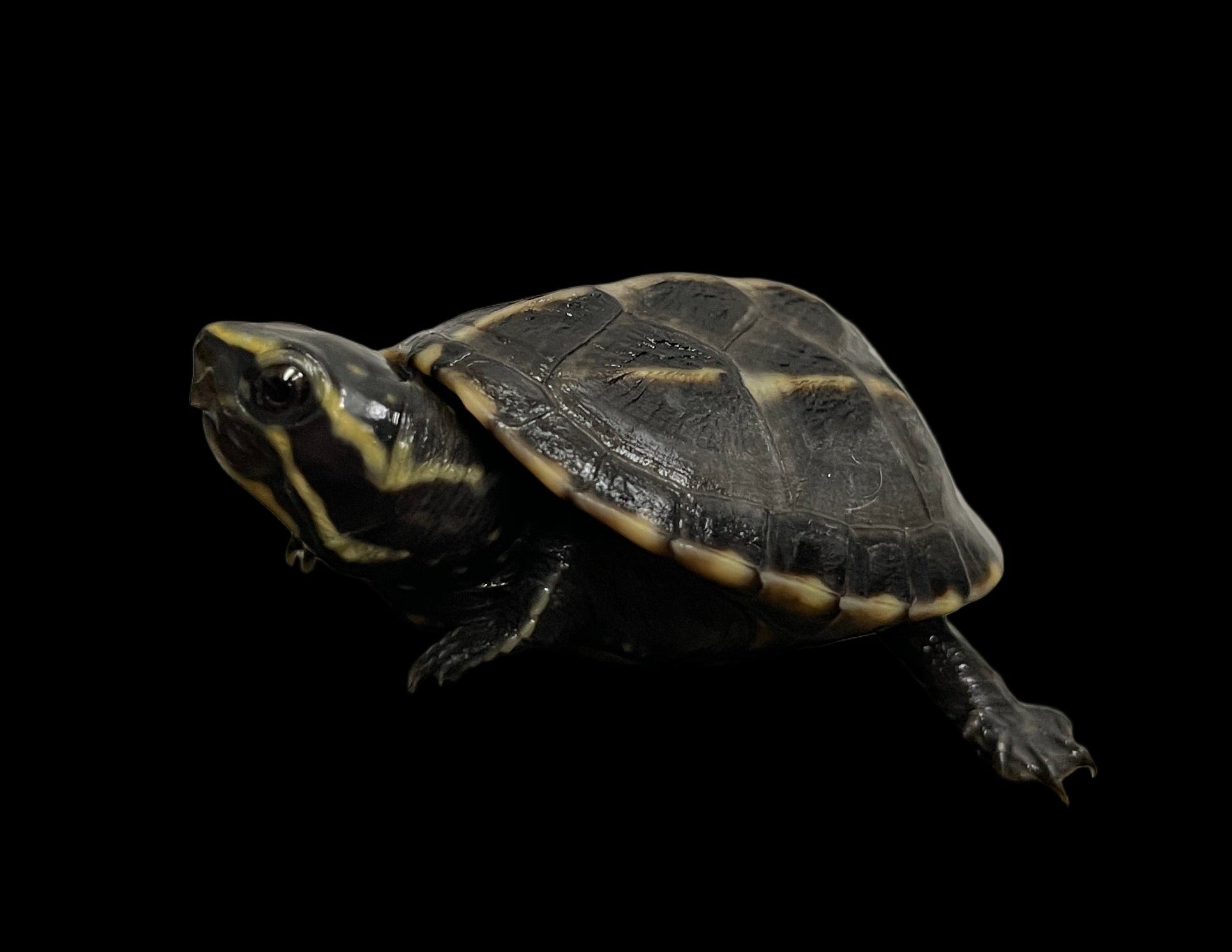
Tortue-musquée à trois bandes
Nom scientifique : Kinosternon baurii
Nom commun : Tortue-musquée à trois bandes, Tortue-musquée rayée
Aperçu de l'espèce
Taille : Les mâles atteignent généralement 9 à 10 cm (3,5 à 4 pouces), tandis que les femelles sont plus grandes, de 10 à 13 cm (4 à 5 pouces).
Apparence : La tortue-musquée à trois bandes est reconnaissable à ses trois bandes longitudinales, de couleur jaune pâle à crème, qui parcourent sa carapace brun foncé ou presque noire. La carapace est lisse, ovale et modérément bombée, les bandes devenant moins distinctes chez les individus plus âgés. La tête est foncée avec de fines rayures ou marbrures jaunes, et le plastron est jaune pâle à beige avec des sutures plus foncées variables. Comme les autres tortues-musquées, elle possède un plastron articulé qui permet une fermeture partielle. Les mâles ont des queues plus longues et plus épaisses et des têtes légèrement plus grandes, tandis que les femelles sont plus larges et ont un corps plus lourd.
Répartition : On la trouve dans le sud-est des États-Unis, principalement en Floride, en Géorgie et en Caroline du Sud, avec des populations isolées dans les régions voisines.
Habitat : Cette espèce habite les environnements d'eau douce peu profonds, y compris les étangs, les fossés, les marais, les mares éphémères et les ruisseaux lents. Elle préfère les fonds boueux ou sablonneux avec une végétation dense et des zones de repos peu profondes. En captivité, elle prospère dans des installations aquatiques modérément peu profondes avec beaucoup de structure.
Comportement : Les tortues-musquées à trois bandes sont des marcheuses de fond plutôt que de puissantes nageuses en eau libre. Elles sont diurnes à crépusculaires, timides au début, mais deviennent souvent des mangeuses audacieuses. Elles passent une grande partie de leur temps à explorer le substrat, à se cacher sous les débris ou à brouter de petits invertébrés. Elles se prélassent occasionnellement.
Soins en captivité
Enclos : Prévoir un enclos aquatique d'une surface minimale de 90 × 45 cm (36 × 18 pouces) pour un adulte. Inclure une profondeur d'eau peu profonde à modérée, des troncs submergés, des grottes rocheuses, de la litière de feuilles et des rebords de repos. Ajouter une plate-forme de bain de soleil sécurisée et entièrement sèche et s'assurer que l'enclos offre une combinaison d'espace de nage ouvert et de couverture dense. La filtration doit être forte mais douce.
Température et humidité :
Température de l'eau : 24 à 27 °C (75 à 80 °F)
Zone de bain de soleil : 31 à 33 °C (88 à 92 °F)
Température ambiante de l'air : 26 à 29 °C (78 à 84 °F)
Éclairage : Fournir un éclairage à spectre complet avec 10 à 12 % d'UVB pour soutenir l'intégrité de la carapace et la fonction métabolique. S'assurer que la zone de bain de soleil est chaude, sèche et facilement accessible.
Régime alimentaire : Offrir un régime omnivore varié comprenant des insectes, des vers, des escargots, des invertébrés aquatiques, des granulés de tortue de haute qualité, de petits poissons, des légumes-feuilles et des plantes aquatiques. Les juvéniles ont besoin de niveaux de protéines plus élevés, tandis que les adultes bénéficient d'un mélange équilibré avec une plus grande quantité de matières végétales.
Comportement en captivité : Les tortues-musquées à trois bandes s'adaptent bien aux environnements structurés et deviennent souvent curieuses envers leurs gardiens. Elles aiment s'enfouir dans un substrat mou, se cacher sous des structures et explorer les zones d'eau peu profonde. Elles sont robustes et sociables lorsqu'elles sont maintenues dans des conditions propres et bien entretenues.
Considérations spéciales
• Éviter l'eau profonde sans rebords de repos – cette espèce est une marcheuse de fond.
• Fournir plusieurs zones de cachette à la fois sous l'eau et à la surface.
• Maintenir une filtration forte mais à faible débit.
• Les juvéniles nécessitent un apport en protéines plus élevé.
Note de taxonomie
Kinosternon baurii est étroitement liée aux autres tortues-musquées nord-américaines et est l'une des espèces les plus reconnaissables du genre en raison de son motif distinctif à trois bandes.
Note sur la génétique
Il n'y a pas de morphes reconnues pour la tortue-musquée à trois bandes. Des variations dans la clarté des rayures, la teinte de la carapace et les marques de la tête se produisent naturellement entre les individus et les populations.