


Avis de non-responsabilité concernant les photos
Description
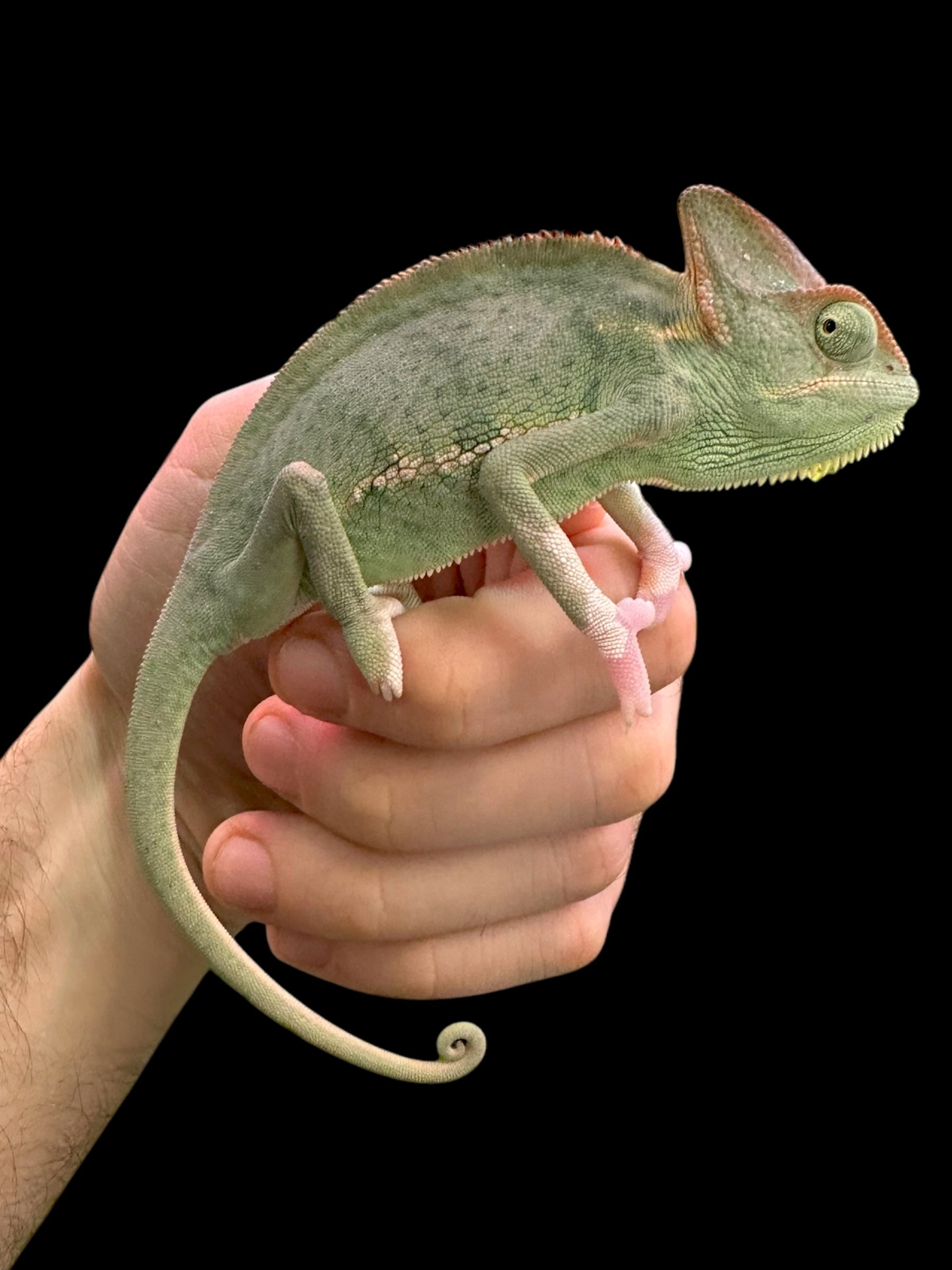
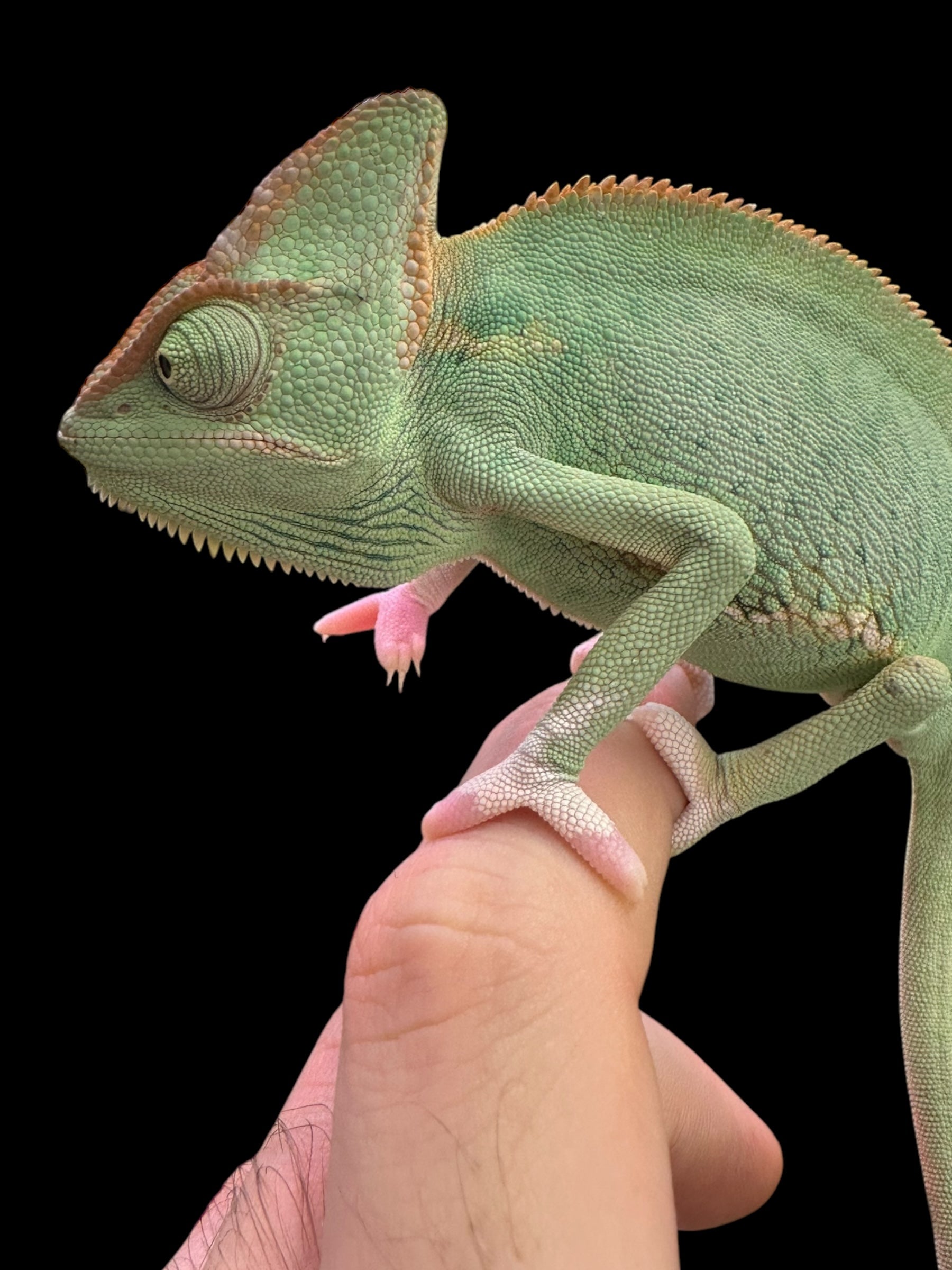
Caméléon casqué (Translucide)
Nom scientifique : Chamaeleo calyptratus
Nom commun : Caméléon casqué translucide
Aperçu de l'espèce
Taille : Les adultes atteignent généralement 18 à 24 pouces (46 à 61 cm) de longueur totale, les mâles étant plus grands, plus colorés et possédant des casques plus hauts que les femelles.
Apparence : Le caméléon casqué translucide est une variation de l'espèce issue d'une sélection génétique, reconnaissable à sa peau partiellement transparente, notamment autour du casque, du visage, des lèvres et des extrémités. Ces zones peuvent apparaître laiteuses, bleuâtres ou légèrement translucides. De nombreux individus présentent un contour des yeux foncé, des taches faciales pâles, ou un contraste plus marqué entre les couleurs en raison de la réduction de l'opacité de certaines écailles. Leur motif de base reste typique de l'espèce, avec des tons verts, jaunes et turquoise formant des bandes verticales le long du corps.
Distribution : Cette morphologie est issue de programmes d'élevage en captivité. Les caméléons casqués sauvages sont originaires du Yémen et du sud-ouest de l'Arabie saoudite.
Habitat (Origine naturelle) : Dans la nature, les caméléons casqués habitent les pentes de montagnes semi-arides, les broussailles et les oueds où ils sont exposés à un fort ensoleillement, à une humidité variable et à un refroidissement nocturne significatif.
Comportement : Les caméléons casqués translucides se comportent de la même manière que les individus de type sauvage : diurnes, solitaires, territoriaux et strictement arboricoles. Ils ne tolèrent pas bien la manipulation et nécessitent un environnement stable et bien ventilé pour prospérer.
Soins en captivité
Enclos : Fournir un enclos d'au moins 36 × 18 × 36 pouces (90 × 45 × 90 cm) pour un adulte, avec une taille améliorée préférée de 48 × 24 × 48 pouces (120 × 60 × 120 cm) pour un meilleur espace d'escalade et une stabilité environnementale accrue. Utiliser des plantes vivantes ou artificielles, des branches robustes, et des parcours d'escalade horizontaux et verticaux. Une excellente ventilation est essentielle, rendant les enclos à façade grillagée ou hybrides idéaux.
Température et Humidité :
Zone de bain de soleil : 95 à 105°F (35 à 40°C)
Température ambiante diurne : 75 à 85°F (24 à 29°C)
Côté frais : 72 à 75°F (22 à 24°C)
Températures nocturnes : 65 à 72°F (18 à 22°C)
Humidité : 50 à 70 %, maintenue par des pulvérisations et en permettant une période de séchage entre les cycles.
Éclairage : Fournir un éclairage à spectre complet puissant avec un UVB à haut rendement (10%). Un éclairage intense favorise les comportements naturels, le métabolisme du calcium et le développement du casque. Un gradient de zones de bain de soleil et d'ombre est essentiel.
Régime alimentaire : Offrir une alimentation insectivore variée comprenant des blattes, des grillons, des vers à soie, des vers-cornes, des larves de mouches soldat noires et occasionnellement des vers de cire. Les caméléons casqués consomment volontiers des matières végétales, donc des légumes verts à feuilles tels que le chou cavalier, la moutarde et le pissenlit peuvent être proposés. "Gut-load" tous les insectes nourriciers et les saupoudrer de calcium fréquemment, avec des multivitamines ajoutées chaque semaine.
Comportement en captivité : Cette espèce prospère en tant que lézard d'exposition et ne doit pas être manipulée fréquemment. Ce sont des grimpeurs actifs, des communicateurs visuels efficaces, et ils montrent des changements naturels de couleur et de posture tout au long de la journée. Les mâles doivent être logés individuellement en raison de leur territorialité.
Considérations spéciales :
• Évitez les manipulations excessives — les réactions de stress sont courantes.
• Assurez une excellente ventilation pour réduire les risques respiratoires.
• Les femelles nécessitent toujours un pondoir, même sans accouplement.
• Évitez les surfaces réfléchissantes pour prévenir les comportements de défense.
• Le trait translucide peut légèrement augmenter la sensibilité à la lumière chez certains individus.
Note de taxonomie
Chamaeleo calyptratus est l'une des espèces de caméléons les plus couramment élevées en captivité en raison de son adaptabilité, de sa coloration vive et de la disponibilité de lignées sélectionnées, telles que la morphologie Translucide.
Note de génétique
Translucide (récessif) : Produit une peau partiellement transparente le long du casque, du visage et des membres, parfois accompagnée d'un contour des yeux foncé et de taches plus claires autour de la tête. Ce trait est maintenu par la sélection en élevage captif.
Des variations naturelles de l'intensité des couleurs, de la clarté du motif et de la taille du casque se produisent également au sein de l'espèce, mais sont considérées comme une diversité génétique normale plutôt que comme un développement de morph distinct.